
Tungsten carbide RFQ reference
Technical report and media kit assets
Use this public reference to estimate tungsten carbide rod and blank weight, convert common density units, and prepare cleaner quote requests before sending drawings or material requirements.
g/cm3 range
Many cemented tungsten carbide grades fall in this practical density range. Always use the selected grade density for a production quote.
conversion factor
Multiply g/cm3 by 0.0361273 to estimate density in lb/in3 for inch-based quote and freight calculations.
best use
Weight estimates are most useful when paired with drawing, grade, quantity, tolerance, finish, and application details.
Why density belongs in the RFQ conversation
Tungsten carbide is much denser than steel, so the weight of a rod, blank, pin, or custom wear part can surprise buyers who estimate from dimensions alone. Density also varies by grade because cemented tungsten carbide combines hard carbide grains with cobalt or nickel binder systems.
For rough planning, a representative density can help estimate material weight and shipping. For quoting and production, use the actual grade density and the correct geometry: finished dimensions for delivered part weight, oversize stock dimensions for material planning, and application details for grade selection.
Density conversion table
For inch-based estimates, multiply density in g/cm3 by 0.0361273 to convert to lb/in3. The values below are planning examples, not a substitute for grade-specific data.
| Planning use | Density | Approx. lb/in3 | Quote note |
|---|---|---|---|
| Lower-density carbide estimate | 13.5 g/cm3 | 0.488 lb/in3 | Use only for rough planning unless the grade is known. |
| Common mid-range shop estimate | 14.5 g/cm3 | 0.524 lb/in3 | Useful for early blank, rod, and shipment estimates. |
| Higher-density carbide estimate | 15.2 g/cm3 | 0.549 lb/in3 | Use grade-specific density before quoting or production. |
Example rod and blank weights
The examples use 14.5 g/cm3, or about 0.524 lb/in3. Weight equals volume multiplied by density. Rod volume uses pi times radius squared times length; rectangular blank volume uses length times width times thickness.
| Example geometry | Volume | Approx. weight | Why it matters |
|---|---|---|---|
| 0.500 in diameter x 6.000 in rod | 1.178 in3 | 0.62 lb | Diameter drives weight quickly because radius is squared. |
| 1.000 in diameter x 6.000 in rod | 4.712 in3 | 2.47 lb | Doubling diameter creates roughly four times the weight. |
| 2.000 x 1.000 x 0.500 in blank | 1.000 in3 | 0.52 lb | Rectangular blanks are simpler: L x W x T x density. |
| 4.000 x 2.000 x 1.000 in blank | 8.000 in3 | 4.19 lb | Oversize stock can materially change quote and freight assumptions. |
Downloadable press asset
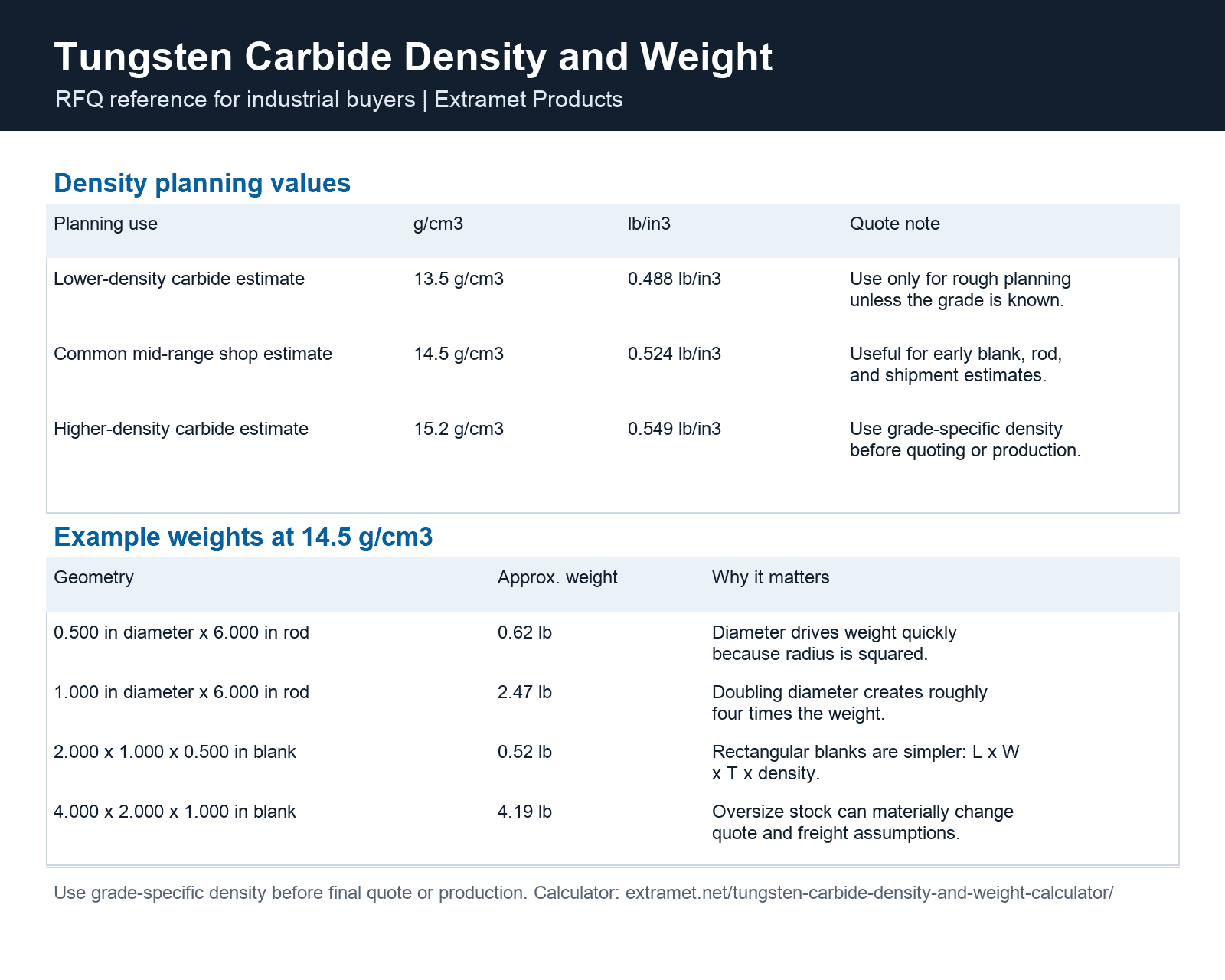
Density and weight summary graphic
A compact PNG version of the planning tables is available for editorial reference, partner sharing, or quick internal use.
What buyers should include with a carbide RFQ
Weight alone is not enough to quote a tungsten carbide component well. The best RFQs connect material, geometry, finish, inspection, and application context.
| RFQ field | What to include |
|---|---|
| Drawing or sketch | Finished geometry, tolerances, critical dimensions, datum needs, and quantity. |
| Grade or application | Known grade, target grade family, or wear mode such as abrasion, impact, corrosion, or galling. |
| Starting form | Rod, blank, stock shape, near-net blank, or finished component requirement. |
| Finish and allowance | Ground, as-sintered, polish, EDM, lapping, oversize stock, or grind allowance. |
| Inspection and documents | Material certs, inspection reports, traceability, and quality requirements. |
How to use this reference
Use the worked examples and conversion table to check an early weight estimate. For a different shape or size, enter your dimensions in the interactive density and weight calculator.
Keep the selected grade density and original dimensions with your estimate. The grade data sheets provide the material basis; the RFQ form connects the estimate to your drawing, stock allowance and quantity.
Editorial update: September 16, 2026. The downloadable PDF is a separate planning summary. Confirm the applicable grade specification before ordering.
Frequently asked questions
Is tungsten carbide heavier than steel?
Yes. Cemented tungsten carbide is generally much denser than steel, so a same-size carbide component will usually weigh substantially more than a steel component.
Can buyers use one density for every tungsten carbide grade?
Only for rough estimating. Production quotes should use the density of the selected grade because binder percentage and formulation affect density and performance.
Should weight be based on finished size or oversize stock?
Use finished size for delivered part weight and oversize stock size for material planning. If grinding allowance is significant, include both assumptions in the RFQ.
What is the fastest next step?
Use the tungsten carbide density and weight calculator for a quick estimate, then send the drawing, grade, quantity, finish, and application notes through the Extramet RFQ form.