
A usable carbide RFQ connects the controlled drawing, material decision, supplied condition and inspection requirements. The goal is to remove assumptions that could make two quotations appear comparable when they cover different work.
If you’re open to either material-supply route, say so in your RFQ; this tool-shank quote with two sourcing options shows an inquiry quoted with customer-supplied and Extramet-supplied carbide.
For a sourcing review, contact Extramet Products with the scope of material supply, finishing and inspection you need.
Build one complete request package
| Attach or state | What to include |
|---|---|
| Drawing | Part number, revision, units, dimensions, datums and marked surfaces |
| Material | Approved grade, allowed substitutes, or application information for selection |
| Supply condition | Blank, partially finished or finished component; allowance and ownership |
| Acceptance | Dimensional inspection, material documents and traceability requirements |
| Commercial details | Quantity, repeat demand, requested date and delivery destination |
Illustrative RFQ cover note
“Please quote 50 carbide guide pins to drawing GP-01 revision C. Finished dimensions and inspection points are on the drawing. Current steel pins lose diameter in abrasive contact; grade selection is open. Please identify the proposed grade, supplied condition, included inspection documents and delivery date. No material substitution without approval.”
This invented example is a format, not a customer record. Attach the actual controlled drawing rather than relying on the paragraph to define geometry. If a requirement is unknown, mark it for review instead of leaving a silent blank.
Download the fillable carbide RFQ worksheet and submit it with the drawing. Extramet’s company and team information helps identify the right contact; the quotation should still confirm material origin and ownership of each operation.
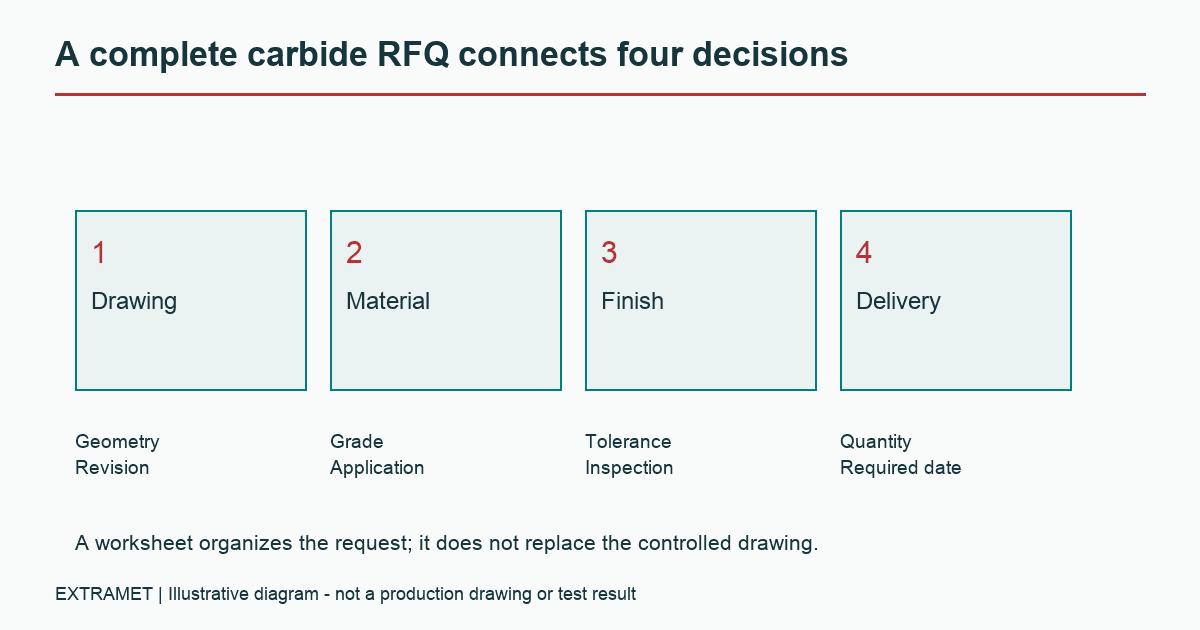
What a manufacturer needs first
A carbide manufacturer can respond faster when the RFQ includes the drawing, grade, tolerance, quantity, and intended use. If a print is incomplete, note which dimensions are critical and which can be adjusted for manufacturability.
If the grade is not known
Do not guess based only on hardness. Describe the contact material, load, speed, lubricant, temperature, current failure mode, and expected service life. That context helps narrow cobalt binder, nickel binder, grain size, and toughness requirements.
Why single-source capability helps
When material supply, grinding, inspection, and technical review live under one roof, there are fewer handoffs. That is especially useful for carbide blanks, pins, punches, rods, and precision-ground components.
Frequently Asked Questions
Can I request a quote without knowing the carbide grade?
Yes. Share the application and failure mode so the manufacturer can help narrow the grade options.
Should I include inspection requirements in the first RFQ?
Yes. Inspection reports, certs, and traceability can affect lead time and quote assumptions.
Why include current part failure details?
Failure details reveal whether the design needs more wear resistance, toughness, corrosion resistance, or geometry changes.
Check the certificate and inspection-report guide before deciding which documents the order requires.
Review the carbide lead-time stages to identify approvals and operations that must be included in the delivery commitment.
Send the drawing, application and quantity through the RFQ form when the requirements are ready for review.
Product questions? Contact Michael Douglas, Extramet Products product expert and Sales and Marketing contact.