Carbide grade support
Tungsten carbide grades explained for real applications
A carbide grade is a specific material recipe designed to balance hardness, toughness, wear resistance, binder behavior, and grindability. The right grade depends on the job the part must do, not only on the shape being quoted. For a step-by-step selection process, use the select the correct tungsten carbide grade guide before the RFQ conversation.
Extramet helps buyers connect grade selection with the manufacturing path: blanks and stock forms, punches and tooling, pins and wear parts, machining, grinding, inspection, and RFQ review.
Current manufacturer references
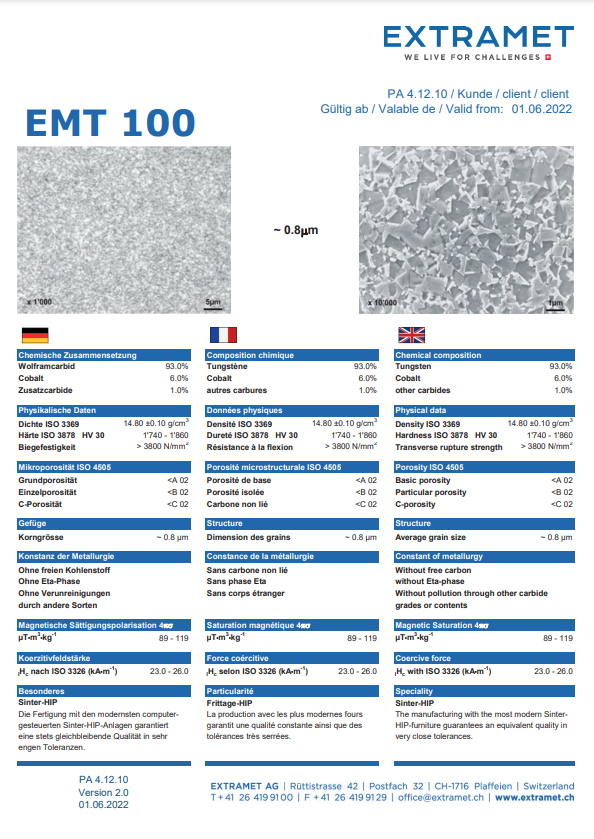
For EMT 100, see the 6% cobalt grade explanation, including the February 3, 2026 manufacturer specification.
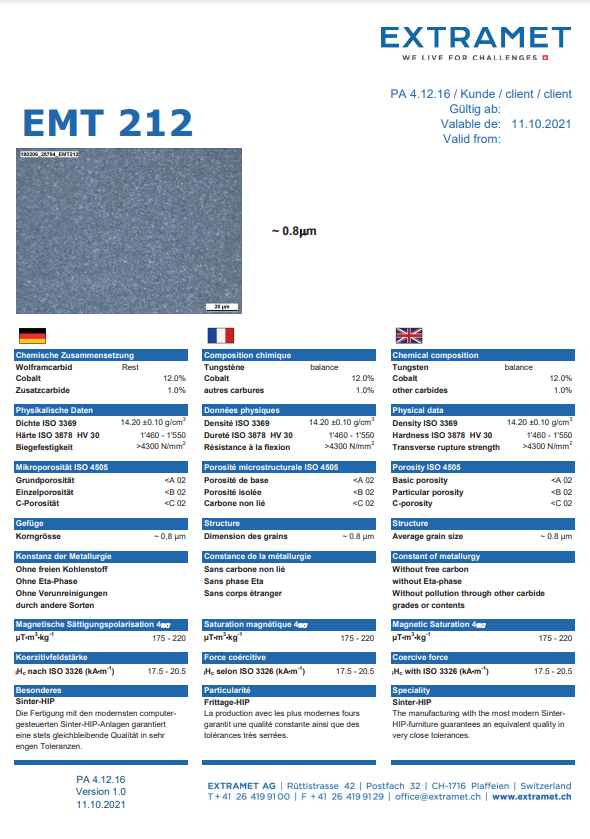
The manufacturer’s 2026 overview lists EMT 212 as 87% tungsten carbide, 12% cobalt and 1% other carbides. The September 2022 tables below retain their original source values. Use the current manufacturer grade documents when specifying an order, and identify the document and revision used for each property.
EMT grade reference from the September 2022 PDF
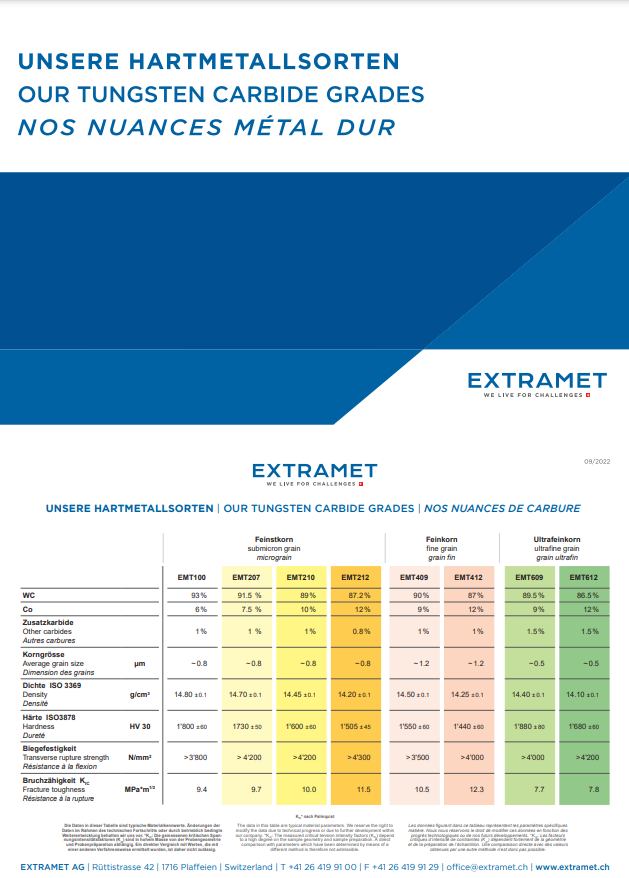
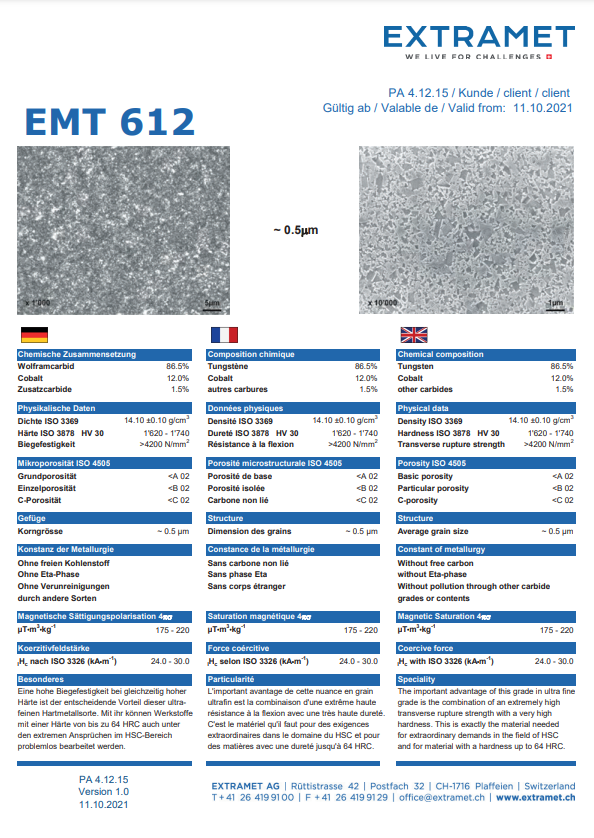
The eight EMT grades below reproduce the typical material values in the grade overview published by Extramet AG and linked on this website. Use this dated reference when discussing composition and material properties; confirm the current grade specification and availability with Extramet before ordering.
On a small screen, scroll each table horizontally to see all properties.
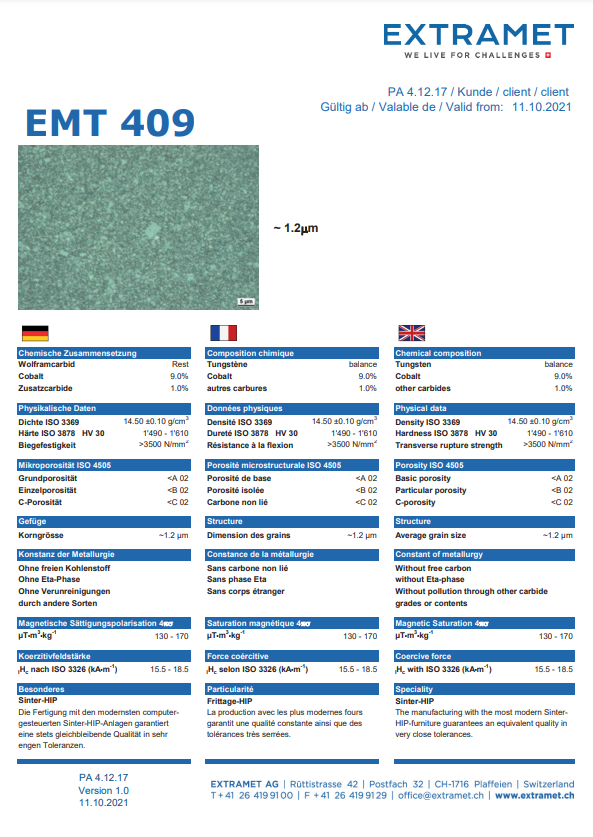
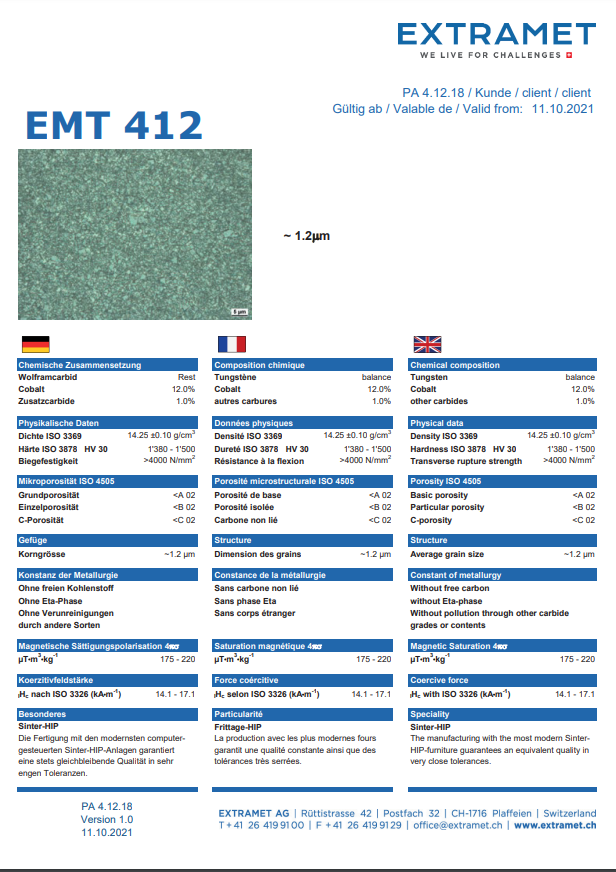
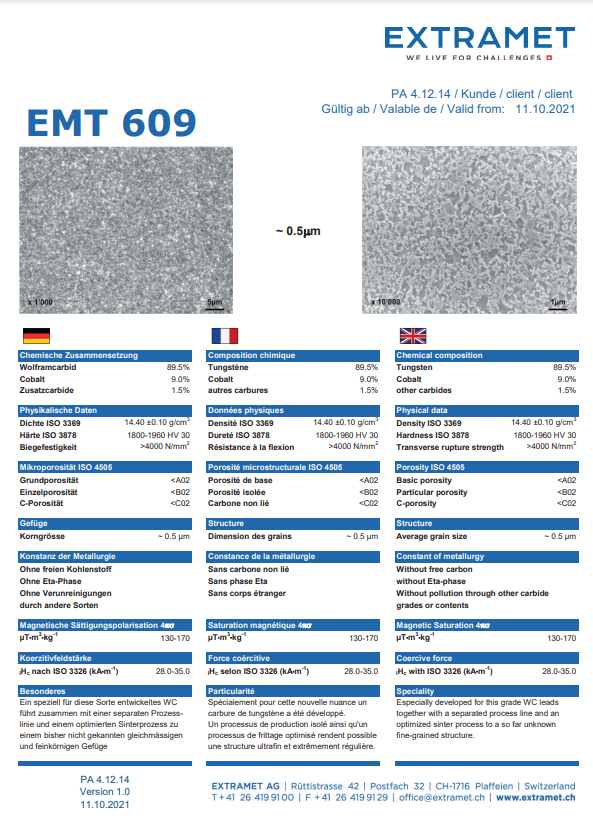
| Grade | Tungsten carbide (WC), % | Cobalt (Co), % | Other carbides, % | Average grain size, µm |
|---|---|---|---|---|
| EMT100 | 93 | 6 | 1 | ~0.8 |
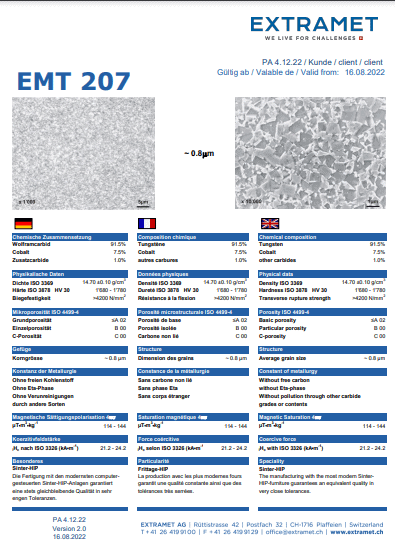
| EMT207 | 91.5 | 7.5 | 1 | ~0.8 |
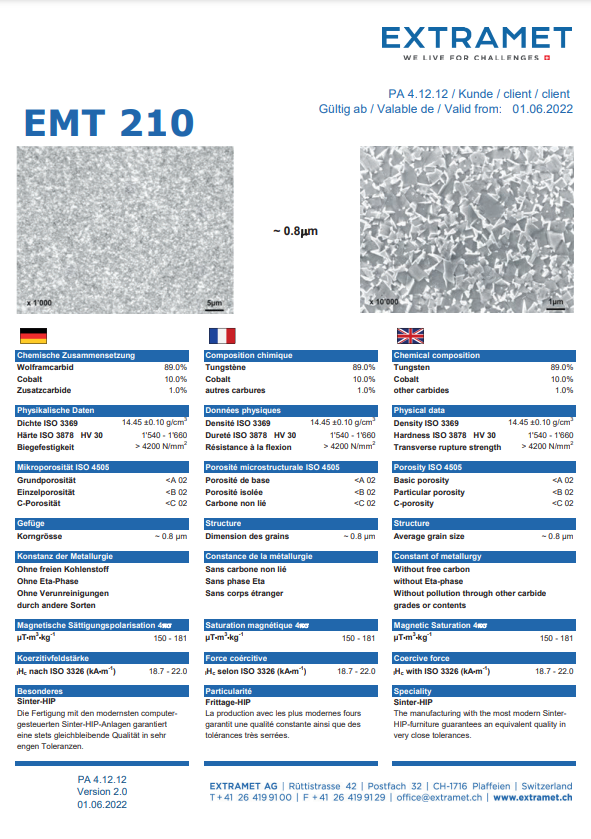
| EMT210 | 89 | 10 | 1 | ~0.8 |
| EMT212 | 87.2 | 12 | 0.8 | ~0.8 |
| EMT409 | 90 | 9 | 1 | ~1.2 |
| EMT412 | 87 | 12 | 1 | ~1.2 |
| EMT609 | 89.5 | 9 | 1.5 | ~0.5 |
| EMT612 | 86.5 | 12 | 1.5 | ~0.5 |
| Grade | Density, g/cm³ ISO 3369 |
Hardness, HV30 ISO 3878 |
Transverse rupture strength, N/mm² | Fracture toughness KIC, MPa·m1/2 |
|---|---|---|---|---|
| EMT100 | 14.80 ± 0.1 | 1,800 ± 60 | >3,800 | 9.4 |
| EMT207 | 14.70 ± 0.1 | 1,730 ± 50 | >4,200 | 9.7 |
| EMT210 | 14.45 ± 0.1 | 1,600 ± 60 | >4,200 | 10.0 |
| EMT212 | 14.20 ± 0.1 | 1,505 ± 45 | >4,300 | 11.5 |
| EMT409 | 14.50 ± 0.1 | 1,550 ± 60 | >3,500 | 10.5 |
| EMT412 | 14.25 ± 0.1 | 1,440 ± 60 | >4,000 | 12.3 |
| EMT609 | 14.40 ± 0.1 | 1,880 ± 80 | >4,000 | 7.7 |
| EMT612 | 14.10 ± 0.1 | 1,680 ± 60 | >4,200 | 7.8 |
These are typical material values from the dated document, not guaranteed specification limits or confirmation of current stock. The source identifies the fracture toughness method as Palmquist and notes that sample geometry and preparation affect the results; values obtained using a different method should not be compared directly. Hardness remains in the source’s HV30 scale.
Download the original Extramet tungsten carbide grade overview (PDF).
What makes one carbide grade different from another?
Grade differences usually come from binder content, grain size, additives, and the way the material balances hardness with toughness. A hard grade can resist abrasion, while a tougher grade can help when impact or chipping is the main concern. In many applications, the best grade is a compromise between wear life and breakage risk.
How to choose a grade for your application
Start with the failure mode
Share whether the part wears, chips, cracks, corrodes, rounds an edge, or loses tolerance.
Match geometry and load
Long thin parts, unsupported features, and sharp edges often need a different discussion than heavy wear blocks.
Confirm the finishing path
Grinding, machining, polishing, and laser etching can all influence how the grade should be reviewed.
Choose products and services for your selected grade
After you narrow the grade family, review options for your part’s geometry and finish: blanks and stock forms, punches and tooling, machining, surface grinding, centerless grinding, or the RFQ form.
Where carbide grades are used
Grade selection matters for wear parts, tooling, pins, punches, bushings, guides, inserts, sleeves, cutting tool blanks, and custom precision components. If the part is used in abrasive contact, high-cycle production, impact, heat, corrosion, or tight-tolerance equipment, the grade choice should be reviewed before manufacturing begins.
Talk with a carbide grade specialist
Send the drawing, current material, grade if known, wear pattern, quantity, tolerance, finish, and operating environment. If the grade is unknown, describe what the part contacts and how it fails. Extramet can help decide whether material supply, a blank, or a finished component quote is the right next step.
Grade questions buyers should answer first
Before asking for a carbide grade recommendation, describe the part role, contact material, wear pattern, load, temperature, corrosion exposure, and what happens when the current part fails. If the current part chips, wears undersize, cracks, corrodes, or loses finish, that failure mode should guide the grade review.
Extramet can work from a known grade, an equivalent grade, or an application description. When the grade is unknown, the most useful information is often the environment, geometry, and performance problem rather than a guessed material number.
How Extramet validates a grade choice
A grade recommendation starts with the drawing, the part role, the wear mode, and the production environment. The team reviews whether the grade needs to prioritize abrasion resistance, toughness, corrosion behavior, finish quality, or dimensional control.
For RFQs, include any required inspection documentation, ISO-related quality expectations, and the reason the current material is being replaced. That gives the grade discussion the real-world context it needs.
Comparing carbide grades against steel?
If the current steel part is wearing, losing size, or failing in abrasive contact, review tungsten carbide vs steel before choosing a grade. The comparison explains when hardness, wear resistance, toughness, density, and finished geometry should drive the material decision.
Tungsten carbide grade chart for RFQ review
A tungsten carbide grade chart should narrow the quoting conversation, not replace the drawing and application review. Use the chart below as a practical cross-reference for the questions Extramet needs to answer before recommending a grade, blank form, grind path, or finished-part route.
| Grade family | What changes | Where it fits | RFQ checkpoint |
|---|---|---|---|
| Fine-grain wear grades | Higher wear resistance and edge support, often with tighter finishing requirements. | Cutting-tool blanks, small punches, guides, precision wear surfaces, and abrasive contact. | Confirm edge condition, finish allowance, inspection method, and whether the part needs grinding after EDM. |
| General-purpose cobalt grades | Balanced hardness, toughness, grindability, and cost for common industrial wear work. | Bushings, dies, wear pads, pins, tool blanks, and replacement parts where the failure mode is known. | Share the current material, failure mode, contact material, operating speed, and quantity. |
| Toughened or higher-binder grades | More fracture resistance with some tradeoff in maximum hardness and abrasion performance. | Interrupted contact, heavier load, larger sections, press tooling, and parts exposed to shock. | Identify impact, side load, unsupported edges, assembly stress, and any history of cracking. |
| Corrosion-aware binder choices | Binder selection can affect corrosion behavior, magnetism, and compatibility with process environments. | Wet, chemical, food-processing, fluid-handling, and washdown applications. | List media, temperature, cleaning chemistry, regulatory expectations, and whether cobalt exposure is a concern. |
| Finished-part machining grades | The grade must work with grinding, wire EDM, micro-EDM, lapping, or polishing without adding avoidable risk. | Parts with slots, profiles, small holes, tight flatness, or surface finish requirements. | Send finished tolerances, surface finish, feature size, flatness, straightness, and any required inspection reports. |
How to read a carbide grades cross reference
Two suppliers may use different grade names for similar material behavior. Treat any cross reference as a starting point. The final choice should consider binder, grain size, hardness, transverse rupture strength, finish method, and the actual failure mode.
When to ask for application review
Ask for review when the part has thin walls, sharp corners, shock load, corrosive exposure, unusually tight tolerances, or a history of cracking. Those factors can matter more than a simple hardness comparison.
Next step: Send the drawing, current material, failure mode, tolerance, finish, and operating environment through the RFQ form. If weight or density affects the quote, use the tungsten carbide density and weight calculator before sending final dimensions.
Frequently Asked Questions
What defines a tungsten carbide grade?
A tungsten carbide grade is defined by its carbide grain size, binder type, binder percentage, density, hardness, toughness, and intended application. These properties determine wear behavior and breakage risk.
How does cobalt binder percentage affect performance?
Higher cobalt binder generally improves toughness and impact resistance, while lower binder content generally improves hardness and wear resistance. The correct balance depends on the application.
When would nickel binder be considered?
Nickel binder may be considered when corrosion resistance or application chemistry is a concern. The best binder choice should be matched to the service environment and performance requirements.
Can Extramet help select a grade for a new application?
Yes. Extramet can review the application, wear mode, geometry, tolerance, and operating environment to help narrow the grade choice before quoting or production.