Nickel-bonded carbide can be worth evaluating where corrosion limits a cobalt-bonded grade, but the binder name alone cannot establish compatibility. The actual fluid, concentration, temperature, cleaning cycle and complete grade formulation belong in the comparison.
Start a carbide grade review for the operating environment with those exposure details. Do not assume that a grade described as corrosion resistant is suitable for every acid, cleaner or process stream, or that a particular nickel-bonded grade is stocked or approved for the application.
Why the binder deserves attention
Cemented carbide combines hard carbide grains with a metallic binder. In some corrosive environments, attack on the binder can undermine the structure near the surface and contribute to material loss. That is different from treating the component as a uniform block of pure tungsten.
Specially formulated nickel-bonded grades are used for some corrosion-wear applications. Their suitability still depends on the formulation and exposure conditions. Published results for a supplier’s grade should not be transferred to another grade merely because both contain nickel.
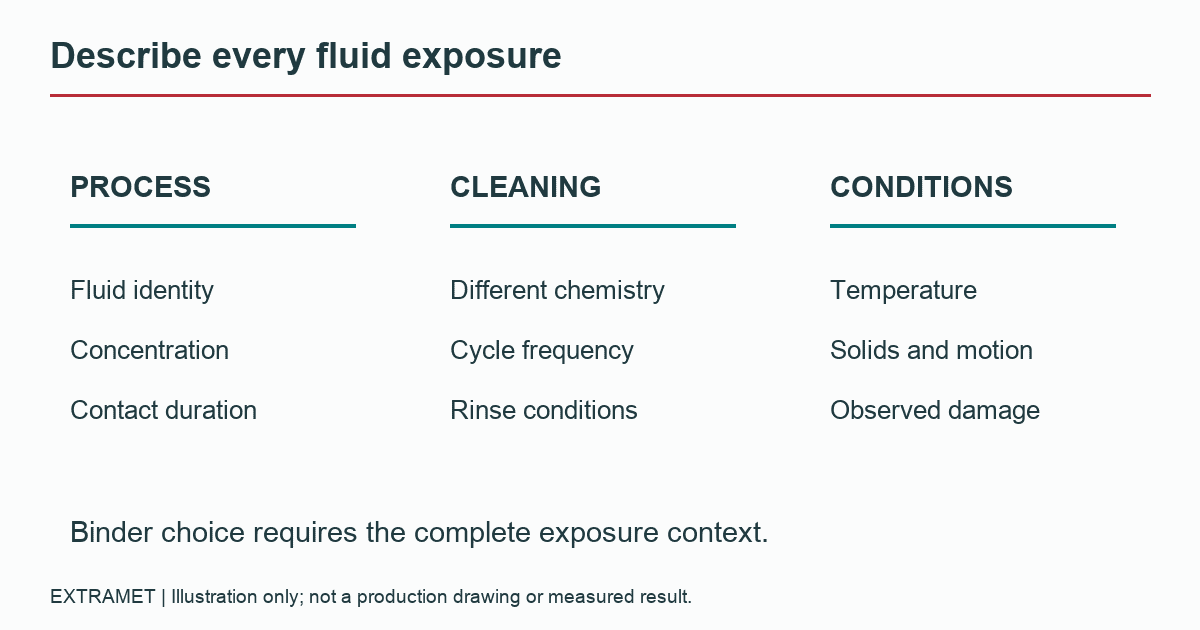
Separate process and cleaning exposure
| Exposure detail | Why the reviewer needs it |
|---|---|
| Fluid identity and concentration | A trade name or pH alone may not describe the chemistry. |
| Temperature and contact time | A brief rinse differs from prolonged hot immersion. |
| Dissolved salts and other constituents | Chemistry beyond pH can affect the corrosive environment. |
| Abrasive solids and motion | Wear can interact with chemical attack. |
| Cleaning chemistry and cycle | The cleaning step may differ substantially from normal service. |
Consider an illustrative guide component that operates in a water-based process but is cleaned with a different solution at the end of each shift. A comparison based only on the operating fluid misses the cleaning exposure. Record both fluids, their concentrations, temperature ranges and contact durations before attributing damage to an unsuitable binder.
If the chemistry is proprietary, ask the chemical supplier which information can be shared for compatibility review. A safety data sheet is useful context, but it is not automatically a grade-specific corrosion test or a complete formulation disclosure.
Compare evidence, not a universal pH cutoff
Supplier corrosion charts represent particular materials and test conditions. Note the solution, temperature, duration and evaluation method before using a chart to shortlist a grade. A pH value from a controlled test is not a guarantee for a plant process containing other salts, solids or cleaning residues.
For wear components exposed to process media, also review the load, support and finished surface requirements. Improving resistance to one mechanism does not remove the need to evaluate mechanical performance and manufacturability.
Define what a useful trial would show
Keep a record of the current part’s grade, geometry, service duration and observed damage. Specify the candidate grade and any geometry or process changes. If several things change at once, it becomes harder to determine which change affected the result.
Agree on measurable observations, such as dimensional loss at identified locations, surface condition or an acceptable service interval. Use equivalent operating conditions where practical. The supplier-evaluation guide can help establish who supplies the material evidence and who answers application questions.
Download the fillable wet-service exposure worksheet (PDF).
Keep approvals separate from material selection
Nickel content does not establish food-contact, medical, drinking-water or other regulatory suitability. Confirm applicable customer and regulatory requirements separately, including any restrictions on material constituents or release into the process. A compatibility discussion is not a compliance certification.
Send the completed exposure worksheet with the drawing and current grade. Request confirmation of available grade options and the evidence supporting any recommendation before authorizing a substitution.
Fluid exposure questions
Is nickel binder always better in wet service?
No. The complete material formulation and the actual environment matter. A fluid-specific review is needed.
Is the operating pH enough to choose a grade?
No. Include fluid composition, temperature, duration, solids and cleaning exposure. Supplier test conditions must be relevant to the intended service.
Technical references
Questions about the supplied carbide part? Contact Michael Douglas, Extramet Products product expert, or send the drawing and requirements for review. Application-specific approval belongs with the responsible technical and quality reviewers.