Evaluate a carbide supplier by the evidence behind its scope, not by the word manufacturer alone. Material production, stocking, grinding and final inspection can be owned by different organizations or facilities.
For a sourcing review, contact Extramet Products with the scope of material supply, finishing and inspection you need.
A supplier-audit scorecard
| Question | Evidence to request |
|---|---|
| Where is material produced? | Named production location and grade documentation |
| Who finishes the component? | Process route and responsibility for subcontracted work |
| What is inspected? | Inspection scope, methods and report availability |
| How is the lot traceable? | Identification connecting the part, material and order |
| Who resolves a nonconformance? | A named contact and agreed corrective-action process |
Use pass, needs clarification, or not applicable for each row. A single total score can hide a critical missing requirement such as traceability. Evaluate must-have requirements first, then compare price and delivery.
Confirm the meaning of U.S. supplier
A U.S. sales or finishing location does not itself establish U.S. origin of the carbide material. Extramet describes its company, Swiss manufacturing background and Latrobe team on its About page. Ask for the specific material origin and processing route on your quote when country-of-origin requirements apply.
For a repeat production part, request a sample of the documentation format and agree on substitution approval. For a stock order, confirm the actual stocked grade and delivery condition rather than assuming the catalog description resolves every drawing requirement.
Look for application understanding
A strong carbide manufacturer asks what the part does. Is the component fighting abrasion, impact, corrosion, heat, galling, or pressure? Is it replacing steel? Does it need to hold a tight diameter, seal against another surface, or survive high-volume cycling? Those answers influence grade, geometry, finish, and inspection expectations.
Application context is especially important when a buyer does not already know the grade. The right recommendation may depend on wear mode, not just hardness.
Review product and process fit
Some projects start with standard stock. Others need custom blanks, cutting tool blanks, carbide punches, pins, or finished wear components. Review the manufacturer’s tungsten carbide products and make sure the available forms match the way your part will be produced.
Also review the manufacturing path. Extramet’s tungsten carbide manufacturing process information explains how raw material selection, pressing, sintering, and finishing all affect the final part.
Do not separate grade from geometry
Grade choice affects hardness, toughness, corrosion behavior, and wear life. Geometry affects stress, finishability, and cost. A reliable manufacturer considers both. For example, a very hard grade may resist abrasion but be less forgiving under shock. A sharper feature may be functional but may also need a controlled radius to prevent chipping.
Use Extramet’s tungsten carbide grades information to frame the conversation before quoting.
Ask about grinding and finishing capability
Many carbide projects succeed or fail during finishing. OD control, roundness, straightness, surface finish, and edge condition all matter. If the part needs centerless grinding, cylindrical grinding, lapping, EDM, or other precision work, make sure those requirements are reviewed before the quote is finalized.
Send a complete RFQ package
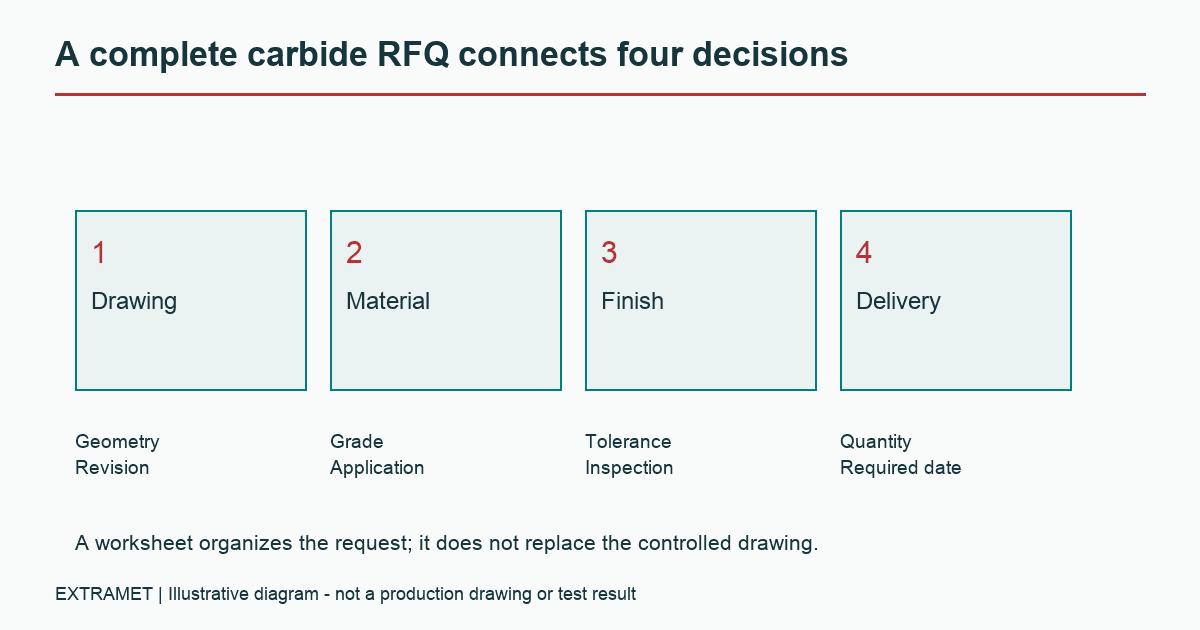
A complete RFQ includes a drawing, grade or performance target, quantity, tolerance requirements, finish requirements, expected use, and any known failure history. If you are replacing another material, include the reason. If the part failed, describe how. If the production environment is abrasive, hot, corrosive, or impact-heavy, say so.
The goal is not to make the RFQ longer. The goal is to make it more useful. Better information helps the manufacturer recommend the right grade, process, and inspection path.
When you are ready, submit drawings and application notes through Extramet’s Request for Quote form.
The manufacturer-versus-distributor guide helps identify who owns material supply, finishing and corrective action.
Check the certificate and inspection-report guide before deciding which documents the order requires.
Product questions? Contact Michael Douglas, Extramet Products product expert and Sales and Marketing contact.