
A permanent mark supports traceability only when someone can connect it to the correct records. Decide how the part identifier relates to the material lot, drawing revision and inspection report before choosing what to mark on the carbide.
Extramet’s part-identification and laser-etching service provides a starting point for discussing the physical mark. The record system around that mark is a separate requirement that the customer and suppliers must agree on.
A readable mark is only the starting point
A part number identifies a design, but may not identify a particular piece. A serial number can identify an individual item within an agreed system. A lot or batch identifier groups items under a defined production or material record. These identifiers answer different questions, and their meanings should be documented.
Do not assume that a number engraved on a component proves material certification, individual inspection or a particular manufacturing origin. It is a pointer. Its usefulness depends on the records it retrieves and the controls that keep that relationship intact.
Follow one fictional part through its records
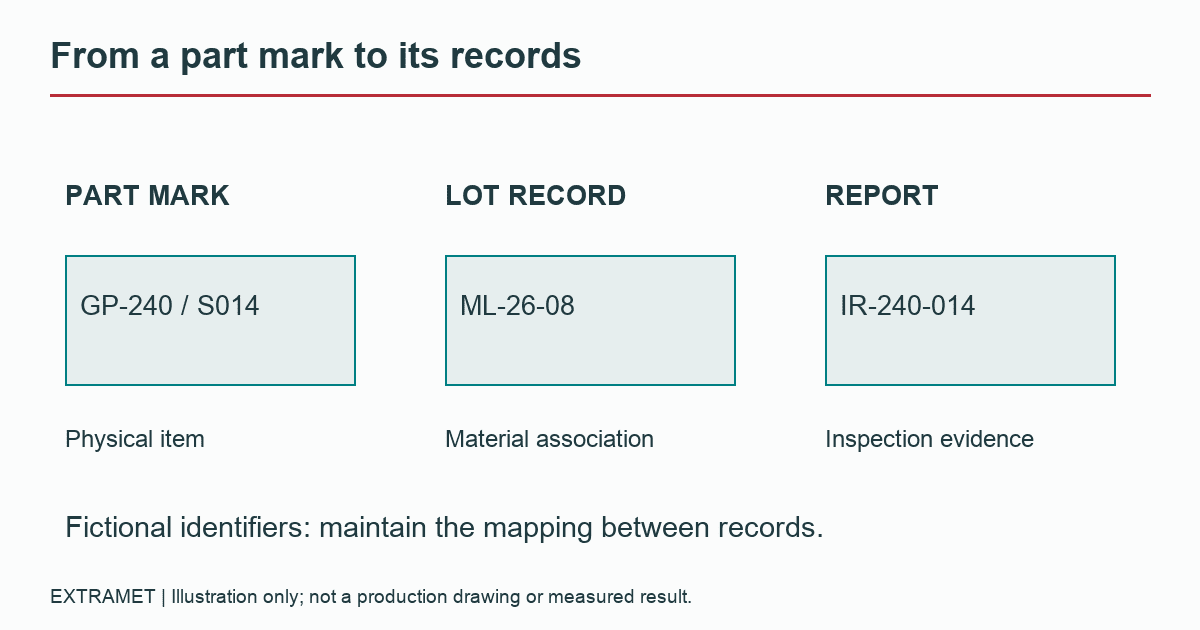
In this illustration, a customer orders carbide guide pads to drawing GP-240, revision C. The physical mark is GP-240 / S014. A controlled record connects S014 to material lot ML-26-08 and inspection report IR-240-014. These identifiers are invented examples, not an Extramet numbering system or customer job.
| Record element | Illustrative entry | Question it answers |
|---|---|---|
| Physical mark | GP-240 / S014 | Which item is in front of us? |
| Drawing record | GP-240, revision C | Which requirements applied? |
| Material record | ML-26-08 | Which recorded material lot was assigned? |
| Inspection record | IR-240-014 | Where are the applicable inspection results? |
| Shipment record | Customer order and packing record | Which delivery contained this item? |
A person investigating that item should be able to follow the chain without guessing whether “014” means the part, the inspection report or the shipment. The identifiers need not be identical, but the mapping must be maintained and available to the authorized people who need it.
Decide who owns each handoff
Agree on who assigns the identifier, who provides the marking instruction, who verifies the mark and who retains the associated record. When a customer assigns serial numbers, the supplier should know how unused, damaged or rejected numbers are handled. A replacement part should not silently inherit an identifier that now points to the wrong item.
Separate the material-lot association from the inspection scope. An inspection report may cover an individual part, a sample or a batch. The guide to material and inspection documents helps distinguish those records, but the actual order must define the required coverage.
Protect the relationship during finishing and rework
Identify the marking location on the drawing or approved instruction. Consider whether a later grinding operation will remove it, whether the marked area contacts another part, and whether the identifier remains readable in service. Confirm mark size and depth with the supplier rather than assigning a generic value.
If a part is reworked, record the disposition and any changes to its applicable drawing or inspection evidence. If a mark cannot be read, use the agreed exception process rather than reconstructing the identity from appearance alone. Traceability is strongest when the unusual cases are addressed before they happen.
Download the fillable part-traceability worksheet (PDF).
Put the record requirements in the request
Include the identifier format, location, record links, report scope and retention expectations in the drawing-based RFQ package. Ask which responsibilities are included in the quote. A request for “full traceability” without these details can mean different things to different teams.
Part identification questions
Does every part need an individual serial number?
That depends on the contract, risk and required record granularity. A batch identifier and an individual serial number provide different levels of identification.
Does a marked code establish compliance by itself?
No. The relevant requirements, verification and records must support any compliance claim. This example does not establish a regulatory or customer-specific marking standard.
Questions about the supplied carbide part? Contact Michael Douglas, Extramet Products product expert, or send the drawing and requirements for review. Application-specific approval belongs with the responsible technical and quality reviewers.