
Is tungsten carbide stronger or harder than steel?
Tungsten carbide is generally harder and far more wear-resistant than steel, while steel is usually tougher under shock, easier to machine, and lower cost. Carbide tends to be the right choice when abrasive wear, dimensional stability, or long service life drive the part. Steel tends to be the right choice when impact, bending, or design changes drive it. The right answer depends on grade, geometry, and how the part will be loaded.
| Decision factor | Carbide is usually better when… | Steel may be better when… | Best next page |
|---|---|---|---|
| Wear and hardness | Abrasive contact, edge wear, or dimensional drift is causing downtime. | The part mainly needs toughness, ductility, or easy rework. | Compare grades |
| Impact and support | The geometry is supported and the grade can be matched to the load. | Shock, bending, side load, or design changes drive the decision. | Ask for grade guidance |
| Finished geometry | The part can route through carbide-specific grinding, EDM, or finishing. | Conventional machining speed and frequent design changes matter most. | Plan machining |
| Part type | Punches, pins, guides, dies, bushings, or wear components need longer service life. | Replacement cost is low and wear is not the limiting failure mode. | Review punches |
For an application-specific answer, send the drawing, contact material, load, speed, failure mode, and target tolerance through the Extramet RFQ form. We can route the request toward blanks, punches, centerless grinding, or cylindrical grinding.
Compare hardness, wear life, temperature stability, and total cost over time.
Use this guide to choose the right material for industrial wear parts, tooling, and production components.

What Is Tungsten Carbide
Tungsten carbide is a composite material made from tungsten carbide particles bonded with cobalt.
It is engineered for extreme wear, high load contact, and dimensional stability.
- Common uses include wear parts, dies, punches, and precision tooling
- Grade selection matters because hardness and toughness can be tuned
- Ideal for abrasion, sliding wear, and edge retention applications
What Is Steel
Steel is an iron based alloy valued for toughness, machinability, and lower upfront cost.
It is widely used when impact resistance and fabrication flexibility are the priority.
- Common uses include fixtures, shafts, structural components, and general tooling
- Heat treated steels improve hardness, but wear resistance is limited in severe abrasion
- Best when impact dominates over abrasion or friction
Tungsten Carbide vs Steel: The Differences That Matter
Hardness and Surface Wear
Tungsten carbide is dramatically harder than steel, including hardened tool steels.
In abrasive environments, this higher hardness translates into less material loss and longer part life.
Wear Resistance and Service Life
When steel parts fail due to galling, abrasion, erosion, or friction wear, carbide is often the upgrade.
Longer wear life reduces downtime, maintenance labor, and the cost of repeated replacements.
For practical upgrade examples, see our guide to tungsten carbide vs hardened steel for wear parts. If the question is about strength language, our article on whether tungsten carbide is stronger than steel separates hardness, compressive strength, toughness, and brittleness.
Toughness and Impact
Steel is generally more impact tolerant.
Tungsten carbide performs best under compressive loads and wear driven contact.
Grade selection and geometry help balance performance for demanding applications.
Heat and Dimensional Stability
Carbide maintains hardness and stability at higher operating temperatures than steel.
This matters in high speed contact, high friction tooling, and production processes where heat accelerates wear.
Cost Over Time
Steel is usually cheaper upfront.
Tungsten carbide often wins on total cost of ownership when downtime is expensive, tolerances are critical,
or replacement frequency is high.
See Our Tungsten Carbide Manufacturing Shop
Material performance only matters if the part is manufactured correctly.
Tungsten carbide must be processed, sintered, and precision ground using specialized equipment to achieve the hardness, tolerances, and wear life engineers expect.
This shop video shows equipment used in carbide component production and finishing.
This is the kind of shop floor capability that separates a simple material comparison from a part that performs in production.
For the full step by step overview, see our tungsten carbide manufacturing process page.
When Tungsten Carbide Is the Better Choice
- Abrasive wear is severe and steel wears too quickly
- Parts must hold tight tolerances over long cycles
- Downtime is expensive and replacement frequency is high
- High friction contact causes galling or rapid surface loss
- Production environments require consistent repeatability
When Steel May Still Be Appropriate
- Impact loads dominate and toughness is the main requirement
- The part is temporary, sacrificial, or easily replaced
- Complex features require extensive machining at lower cost
- Wear conditions are moderate and heat is controlled
- Short lead time prototypes are needed before upgrading material
Why Engineers Choose Extramet
We manufacture tungsten carbide components engineered for real wear conditions, tight tolerances, and repeatable production.
If steel parts are wearing out too fast, we can help you evaluate an upgrade path to carbide.
- Custom tungsten carbide parts built to application requirements
- Grade selection support for hardness, toughness, and wear life
- Precision grinding and finishing for demanding tolerances
- Consistent quality control and repeatability
Frequently Asked Questions
Start with the failure mode, not the material name
Carbide is often the better choice when steel is wearing away, losing size, or failing in abrasive contact. Steel can still be the better choice when bending, shock, or ductility matters more than surface wear. The right comparison starts with what the current part is doing in service.
For small wear components, compare the geometry and contact conditions on carbide pins or carbide punches. If the part also needs finished OD features, bring the drawing into the conversation before assuming the material change is the whole solution.
Compare replacement cost using a measured trial
A useful cost comparison includes the component, changeover, scrap and good output. For example, if a steel replacement plus changeover costs an assumed USD 100 and produces 10,000 good parts, cost is USD 0.01 per good part. A carbide replacement plus changeover costing an assumed USD 220 must exceed 22,000 good parts to beat that figure, before other costs are considered.
This is hypothetical break-even arithmetic, not a measured Extramet case or a wear-life guarantee. Use actual results from matched operating conditions before approving a production change. A carbide part that chips early has not delivered the expected economic benefit even if it resists abrasion.
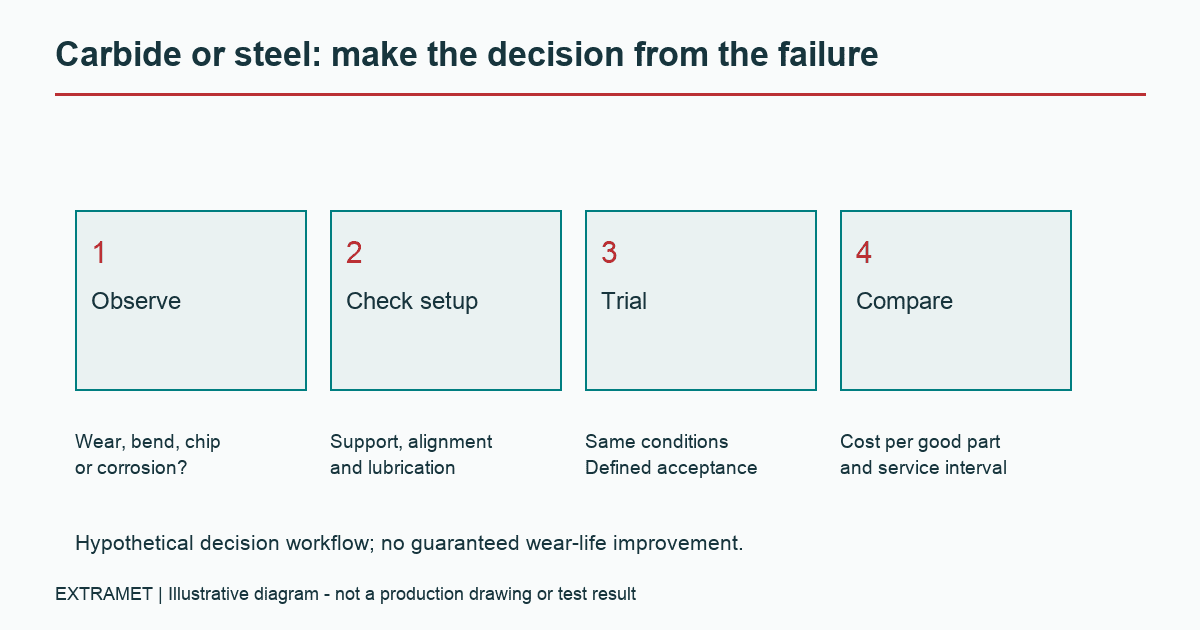
Plan a controlled replacement using the steel-to-carbide trial checklist rather than assuming the upgrade will pay for itself.
Product questions? Contact Michael Douglas, Extramet Products product expert and Sales and Marketing contact.
Comparing carbide and hardened steel for a 3D printer nozzle
For a nozzle material change, compare the complete nozzle and printing conditions. Record the filament and filler, orifice size, hot-end interface, temperature, flow requirement, and the wear or print-quality problem you need to solve. A hardness comparison alone cannot establish fit, operating temperature, or service life.
Use the tungsten carbide 3D printer nozzle page to prepare a product inquiry and sample evaluation. Include the current nozzle drawing or part number, and define acceptance criteria for your actual printing application.