
Choose the blank grade for the finished part, not just for ease of purchasing the starting material. The service load, edge geometry and finishing route remain relevant even when the purchase order is for an unfinished blank.
Use the carbide blank requirements to define the starting material and supplied condition.
Two different blank-selection conversations
| Illustrative project | What to discuss before selecting material |
|---|---|
| Small cutting tool with a fine edge | Edge stability, work material, interrupted contact, grinding and coating route |
| Supported wear blank with a broad contact face | Abrasion, impact, contact pressure, environment and final surface finish |
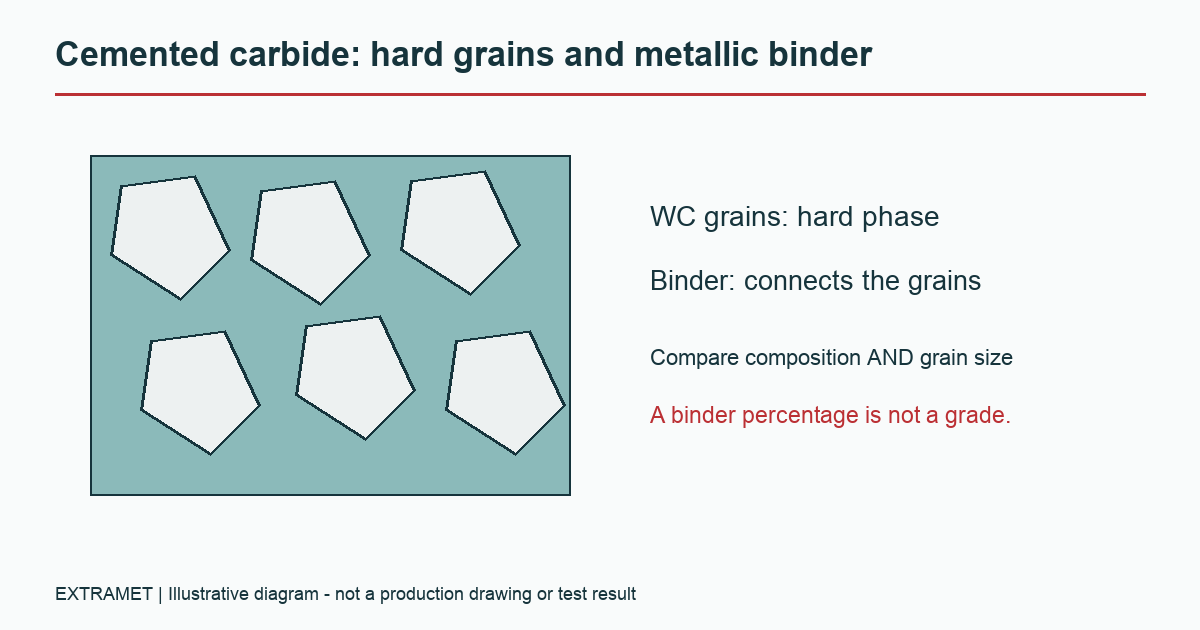
Neither example identifies a specific grade. A fine cutting edge and a supported wear surface can need different balances of hardness and toughness. Compare the actual Extramet grade information rather than assuming one binder percentage provides equivalence.
Control substitutions before they reach the grinder
List the approved grade, or explicitly state that grade selection is pending. A proposed substitute should include the supplier designation, binder information, grain description and relevant property data with their test basis. Obtain approval before material is shipped or finished.
Also identify the finishing owner. A substitution can affect how a thin feature or edge behaves during grinding. Keep the original and proposed material records with the drawing revision and trial result so the next order repeats the accepted condition.
The blank is not the final decision
A carbide blank is a starting form. Grade selection should anticipate the final part’s wear mode, tolerance, geometry, and operating conditions.
Binder and grain size
Cobalt binder percentage and grain size help tune hardness and toughness. Nickel binder may be considered where corrosion resistance matters. These properties also influence density and finishing behavior.
How to narrow choices
Describe the application, contact material, load, speed, lubrication, temperature, and current failure mode. That context is more valuable than asking for the hardest possible grade.
Frequently Asked Questions
Should I choose the hardest blank grade?
Not automatically. The hardest grade may chip if the application requires toughness.
Does binder content affect density?
Yes. Binder percentage changes density along with hardness and toughness.
Can Extramet help select a grade?
Yes. Application details and a drawing help narrow the grade options.
Use the grade-selection workflow to connect the application evidence with a documented material choice.
The tool-blank drawing guide separates size limits, straightness, end condition and surface finish.
Send the drawing, application and quantity through the RFQ form when the requirements are ready for review.
Product questions? Contact Michael Douglas, Extramet Products product expert and Sales and Marketing contact.