
A cutting-tool blank specification should distinguish the dimensions needed for tool manufacture from the finished cutting geometry. Diameter alone does not establish straightness, end condition, surface finish or available grinding stock.
Start a toolmaking request with the cutting-tool blank requirements and the controlled print.
A drawing callout that can be inspected
Illustrative dimensional example: OD 10.000 +/- 0.005 mm gives a size range of 9.995 to 10.005 mm. That says nothing by itself about straightness or the location of the axis. State those requirements separately where they matter. This is a drawing example, not an Extramet capability guarantee.
| Specify | Why the toolmaker needs it |
|---|---|
| Diameter and limits | Defines stock removal and blank acceptance |
| Length and end condition | Allows end preparation and workholding |
| Straightness requirement | Controls usable length and setup |
| Surface finish and surfaces | Separates grinding finish from geometry |
| Grade and lot identification | Maintains the intended material and traceability |
Do not treat h6 as one tolerance value
An h6 shaft tolerance uses the nominal-size range and the applicable ISO tolerance tables. Write the nominal diameter with the tolerance designation, or specify agreed numerical limits. A label such as tight h6 is not a substitute for the correct size-dependent limits.
Standard reference: ISO 286-2, tables of tolerance classes and limit deviations. For nonstandard blanks, attach the controlled print and identify who will grind the final tool features.
A complete blank spec prevents rework
Cutting tool blanks become drills, end mills, reamers, and special tools. Small issues in diameter, straightness, finish, or grade can become expensive once the blank moves into tool grinding.
Ground vs unground blanks
Ground blanks can save preparation time and improve consistency. Unground blanks may make sense when the toolmaker wants full control of final diameter and finish.
Connect the blank to the tool
If a blank is being sourced for a specific cutting tool, include the finished tool type and work material. That context helps with grade and size recommendations.
Frequently Asked Questions
Are cutting tool blanks always round rods?
Often, but not always. The blank form depends on the tool type and manufacturing path.
What is h6 tolerance?
It is a tight shaft tolerance often used for precision ground rods. Confirm the exact dimensional requirement on the print.
Why include work material?
The material the tool will cut can influence grade and blank selection.
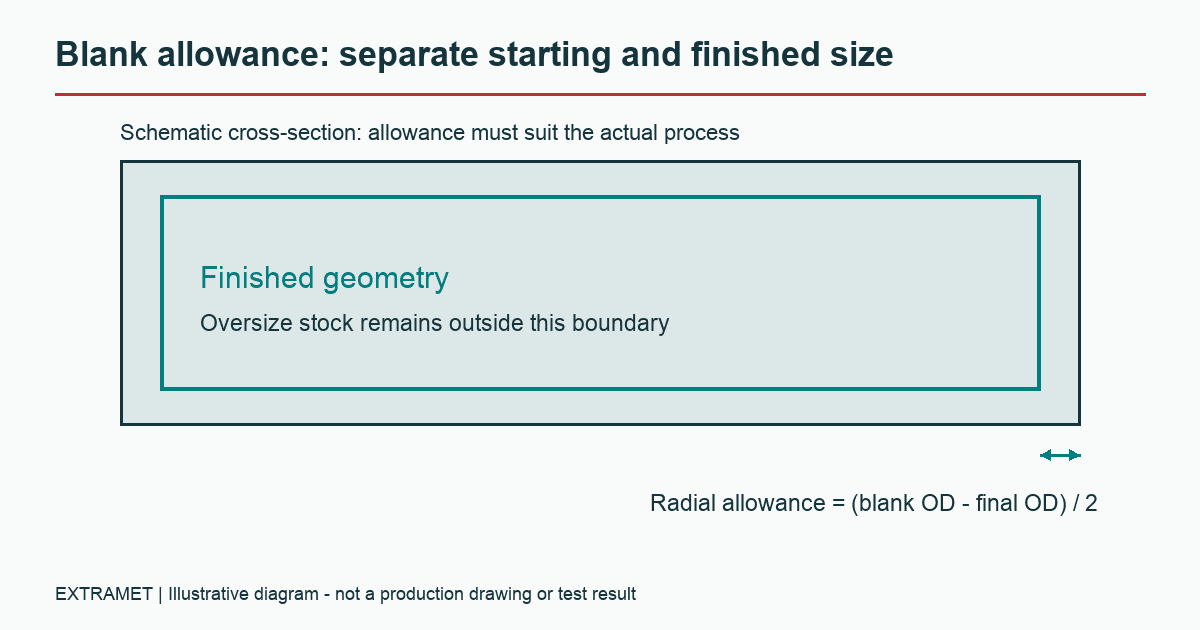
Check the grind-allowance example when starting dimensions and finished dimensions are different.
For unfinished material, review blank grade selection before approving substitutions or releasing downstream grinding.
Send the drawing, application and quantity through the RFQ form when the requirements are ready for review.
Product questions? Contact Michael Douglas, Extramet Products product expert and Sales and Marketing contact.