
EDM and diamond grinding solve different carbide geometry problems. Select the route by feature access and required surface condition, then confirm how final dimensions and surface integrity will be accepted.
Review the carbide machining and finishing options against the complete drawing.
Compare the feature and the finishing requirement
| Process | Geometry question | Surface and access question |
|---|---|---|
| Wire EDM | Can a wire pass through the intended profile? | How are start access, internal corner limits and final surface condition handled? |
| Sinker EDM | Is the cavity accessible to the electrode? | How do electrode shape, corner detail and discharge conditions affect finishing? |
| Diamond grinding | Can the wheel reach and support the required surface? | What wheel access, radii and finish are practical? |
Electrical discharge machining requires an electrically conductive workpiece. The specific carbide grade and process settings matter. EDM can alter the near-surface condition through its thermal removal process; requirements for any follow-up finishing should be agreed with the processor, not assumed from a generic depth allowance.
Describe critical surfaces on the print
An internal profile may be accessible by wire while an OD or sealing surface calls for a different final operation. Mark the surfaces where roughness, edge condition or fatigue-sensitive behavior matters. A feature being cut successfully does not establish that its surface meets the application requirement.
Ask the quote to name each operation and its owner, including any specialist process outside Extramet’s scope. Do not assume that all EDM variants or post-processing routes are available from the same facility.
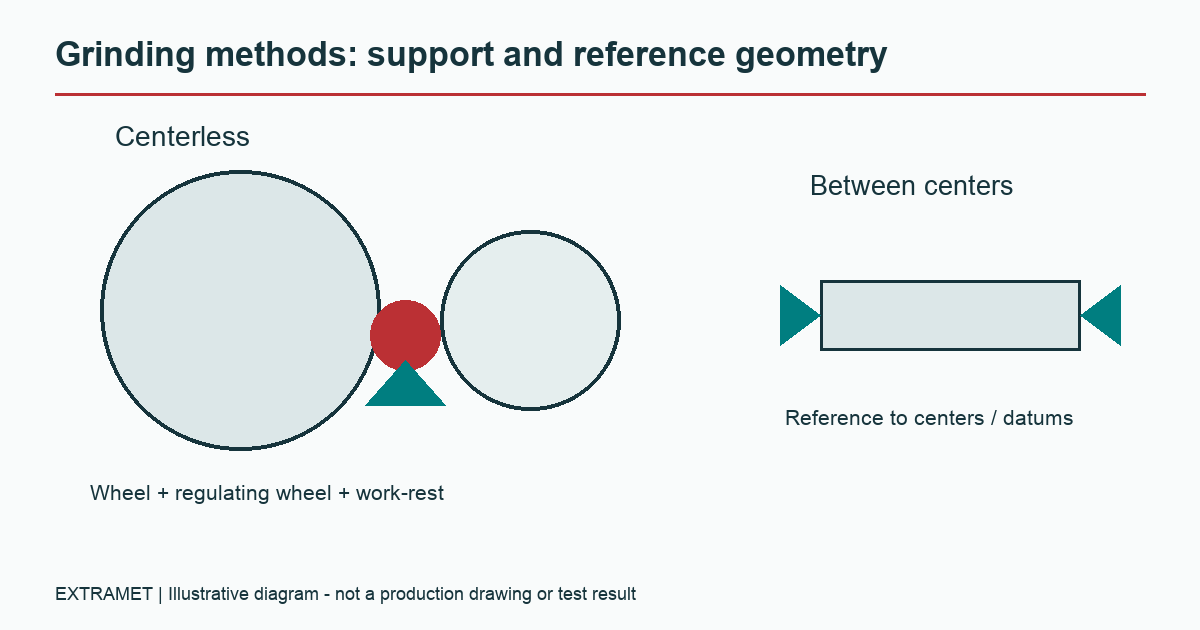
Process choice is geometry driven
Carbide finishing often uses specialized processes because conventional machining is limited. Diamond grinding is strong for accessible surfaces, OD features, and flatness. EDM can be useful when geometry is difficult to reach with a wheel.
Surface and edge considerations
Grinding and EDM can leave different surface and edge conditions. The final application should define whether finish, micro-edge integrity, or dimensional repeatability is most important.
Combine processes when needed
Some carbide components may use more than one process. A blank can be ground for primary dimensions and EDM-cut or finished for more complex features.
Frequently Asked Questions
Can carbide be EDM machined?
Yes, conductive carbide grades can often be EDM processed, depending on geometry and requirements.
Is grinding more accurate than EDM?
It depends on the feature. Grinding is excellent for accessible precision surfaces and ODs; EDM is useful for complex shapes.
Which process is cheaper?
Cost depends on geometry, tolerance, finish, quantity, and setup needs.
The carbide machining explainer separates material-stage constraints from final finishing requirements.
Use the surface-finish callout guide to state the parameter, units, marked surface and measurement basis.
Send the drawing, application and quantity through the RFQ form when the requirements are ready for review.
Product questions? Contact Michael Douglas, Extramet Products product expert and Sales and Marketing contact.