
An OD size tolerance, roundness requirement and surface-finish requirement control different things. Put each functional requirement on the drawing and agree on how it will be inspected before the part is ground.
For an OD review, send the drawing and starting condition through the centerless grinding service.
A dimensional example is not a capability promise
| Illustrative callout | What it establishes | What remains separate |
|---|---|---|
| OD 10.000 +/- 0.005 mm | Accepted size range 9.995 to 10.005 mm | Roundness, straightness and datum relationships |
| Roundness requirement | Permitted form variation under the specified standard | The accepted OD size range |
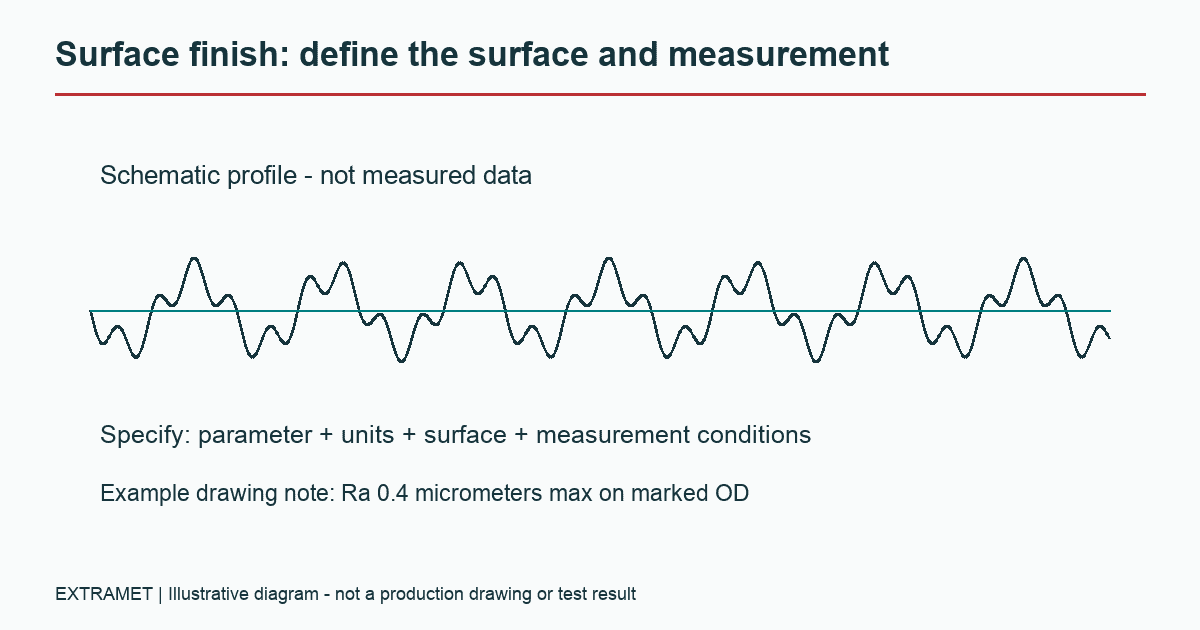
| Ra 0.4 micrometers max on OD | A specified roughness parameter on a marked surface | Waviness, defects and geometric form |
These examples explain specification structure; Extramet must confirm achievable limits for the actual grade, length, geometry and quantity. A micrometer checks size at its contact locations. A separate form measurement may be needed to establish a specified roundness or straightness requirement.
Keep inch and metric values consistent
One inch is exactly 25.4 mm, so 0.0001 inch equals 0.00254 mm, not 0.005 mm. Mark the governing units on the drawing and avoid conflicting rounded conversions. See the NIST length-unit reference.
Ask the quotation to identify the inspection method, sampled quantity and report scope. State whether acceptance applies to the entire length or designated zones, particularly for parts with different working and supported sections.
Tolerance should match function
A carbide rod used as raw stock does not always need the same tolerance as a finished pin or gauge feature. Over-specifying tolerance can add cost without improving performance.
Diameter is not the only dimension
For precision carbide components, roundness, straightness, finish, end condition, and length can all affect assembly and function.
Inspection planning matters
If a customer needs a dimensional inspection report, the RFQ should define which dimensions are reported and how they are measured.
Frequently Asked Questions
Can carbide be ground to very tight OD tolerances?
Yes, when geometry, grade, starting stock, and inspection requirements support the tolerance.
Does surface finish affect tolerance?
It can affect measurement and function, so finish should be specified separately.
Why include inspection method?
Different measurement methods can produce different practical interpretations of tight tolerances.
Use the surface-finish callout guide to state the parameter, units, marked surface and measurement basis.
Compare centerless and cylindrical workholding when geometry or datum relationships control the route.
Send the drawing, application and quantity through the RFQ form when the requirements are ready for review.
Product questions? Contact Michael Douglas, Extramet Products product expert and Sales and Marketing contact.