
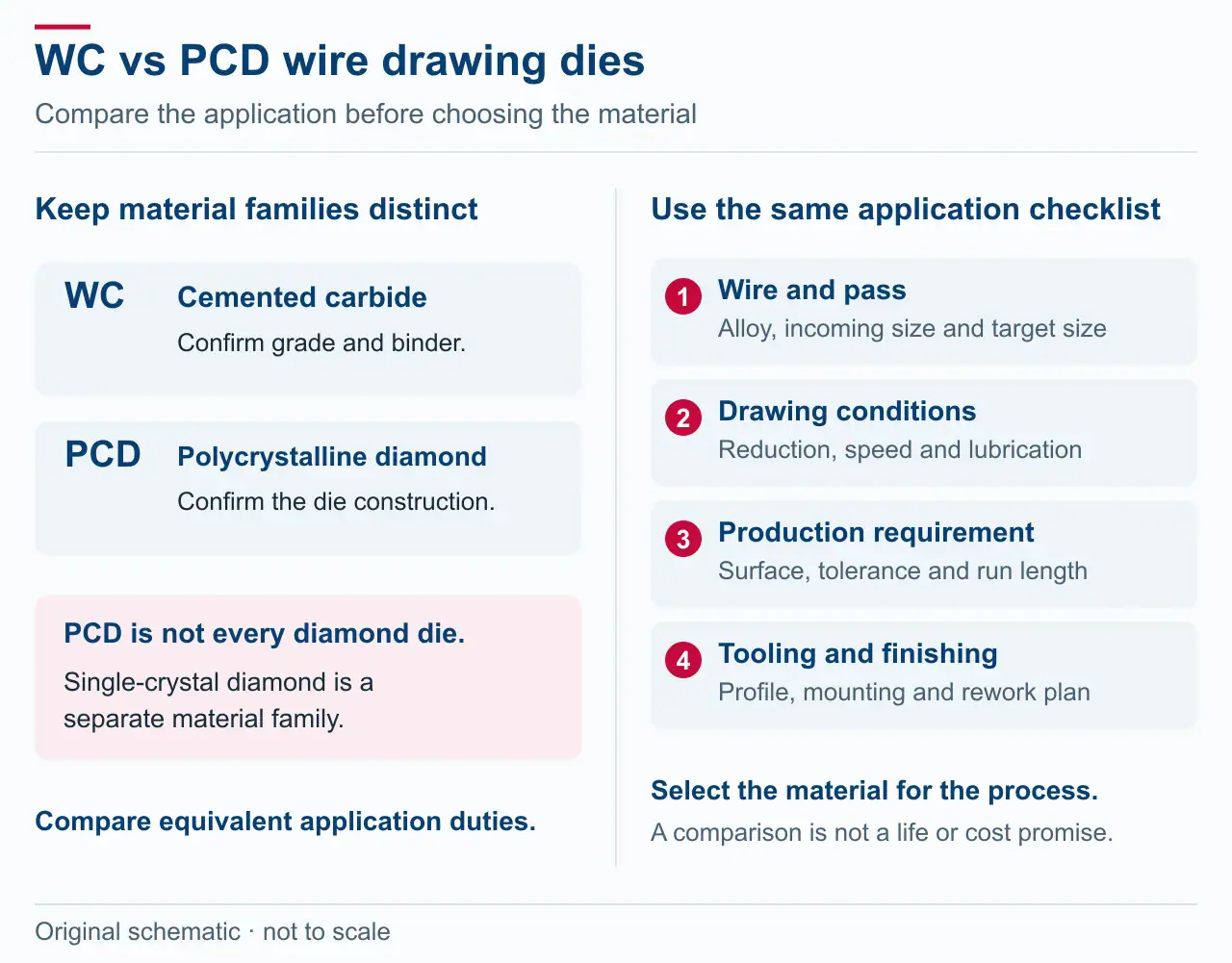
Tungsten carbide and polycrystalline diamond serve different drawing-die requirements. Carbide is commonly considered for ferrous rod and shorter or trial runs; PCD is often evaluated for abrasive wire and long production runs. The choice also depends on wire size, profile and finishing requirements, not the material name alone.
This comparison supports a decision about the drawing material. Extramet’s carbide drawing-die nib inquiry page concerns a carbide component and its supplied condition. PCD is included here as a material comparison, not as an implied PCD offering through that RFQ.
The drawing surface identifies the material
In a carbide drawing die, the working bore is formed in the carbide material. PCD contains many diamond grains rather than one diamond crystal. PCD blanks can be supported or unsupported, so an outside view alone may not identify the material that contacts the wire.
One supported construction has a PCD core bonded to a tungsten-carbide ring. Hyperion’s PCD blank catalog illustrates this arrangement. The wire passes through the diamond core; the surrounding carbide provides support. Calling that entire blank “carbide” would obscure the material at the working surface.
The distinction matters when comparing quotations. A carbide nib, a supported PCD blank and a finished cased die describe different material or manufacturing stages. Compare items that have the same agreed scope before drawing conclusions from their descriptions.
Match the comparison to the wire and the run
As application guidance, Esteves positions tungsten carbide dies for ferrous rod-size wire and relatively short production or trial runs. It also describes different carbide grades and both wet and dry drawing applications. This makes carbide a relevant option when evaluating a new wire or a changing production requirement; it is not a universal restriction to short runs.
The same manufacturer’s PCD die overview emphasizes abrasive wire and longer production runs. That positioning makes repeated production and wear behavior useful comparison inputs. It does not establish a guaranteed life ratio between a particular PCD die and a particular carbide grade.
Write down the actual wire alloy and condition, incoming and finished dimensions, and whether the work is a trial, a changing product mix or a repeated production job. Those descriptions provide a more useful basis for comparison than “high volume” without any process context.
Grain structure is part of the specification
“PCD” is not a complete grade specification. PCD products are offered in different grain sizes and support configurations. Carbide likewise comes in different grades. A family-level comparison should therefore lead to specific candidate materials, rather than treating all diamond dies or all carbide dies as interchangeable.
Preserve the supplied grade identification when reviewing a sample or service record. If one die performed differently from another, the description should retain both the material grade and the profile. Otherwise, the comparison can accidentally combine a change in material with a change in the working geometry.
Separate the blank from the finished bore
A die blank becomes a working tool through further operations defined by its supplied condition and the finished design. Hyperion’s supported-PCD documentation separates the core construction from piercing and profiling. A finished drawing surface is therefore not established simply by ordering an outside diameter or a material family.
Keep the comparison at the same stage: blank against blank, or finished die against finished die. Identify who provides the bore geometry, finishing and casing where applicable. The existing guide to near-net and finish-ground carbide explains the wider handoff between supplied dimensions and downstream work.
Use evidence from the actual application
A useful comparison record follows the wire dimensions and surface condition, observed die wear, and the reason a die is changed or reworked. Keep the wire, drawing conditions and inspection method consistent enough to interpret the result. A material claim without that context cannot show whether the working profile, the wire or another process change drove the difference.
For a carbide nib, share the profile drawing when available, the wire material and the condition in which you need the component supplied. Extramet reviews these inquiries with its supply partner. Start with the information you have.