
Near-net and finish-ground describe different delivery responsibilities. The economical choice depends on which supplier can reliably complete the final surfaces and who accepts the finished dimensions.
Use the carbide blank requirements to define the starting material and supplied condition.
Agree on the condition that changes hands
| Supply condition | Supplier acceptance | Downstream responsibility |
|---|---|---|
| Oversize blank | Agreed starting dimensions and material | Final geometry, finish and inspection |
| Near-net form | Defined intermediate shape and allowance | Remaining finishing operations and final acceptance |
| Finish-ground component | Specified finished surfaces and tolerances | Assembly or any explicitly excluded operations |
Make the handoff measurable
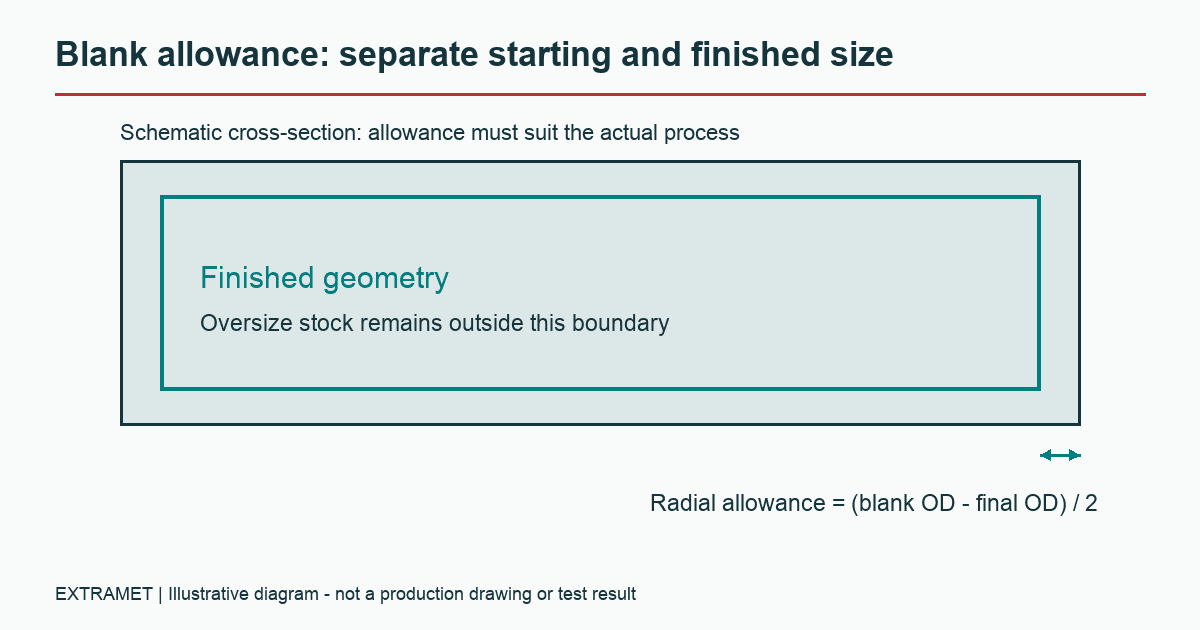
For an illustrative 10 mm finished rod, an order for a 10.4 mm starting blank is not an order for an accepted 10 mm component. The drawing package should identify both sets of dimensions and name the shop responsible for final grinding. If only selected surfaces are finished, mark them individually.
Wire drawing die nibs require the same distinction: identify the blank dimensions, core opening, finishing allowance and which internal profile features must be supplied finished.
At equal length, reducing OD from 10.4 to 10.0 mm removes about 7.54% of the starting cylinder volume. That is a geometric estimate, not a machining-time estimate. Setup, workholding and inspection can dominate a short run even when little material is removed.
Compare quotations at the same acceptance point. A low blank price plus customer finishing cannot be compared directly with a fully inspected finished-part price without accounting for the remaining work.
Why near-net exists
Carbide is expensive to grind compared with many metals. A near-net blank can reduce unnecessary material removal while leaving enough stock for final size, finish, and edge condition.
When finish-ground is better
If the buyer does not have carbide grinding capability or the part needs tight tolerance at delivery, a finish-ground component may reduce risk and internal processing time.
The handoff question
Every project should define who owns final dimensions, inspection, and part acceptance. That decision shapes blank size, tolerance, price, and schedule.
Frequently Asked Questions
Is near-net the same as finished?
No. Near-net is close to final shape but usually still needs finishing.
Why not always order finish-ground?
Some buyers prefer to finish in-house for proprietary geometry, scheduling, or process control.
Can near-net blanks reduce cost?
They can when they reduce grinding time and material waste without adding manufacturing complexity.
Check the grind-allowance example when starting dimensions and finished dimensions are different.
Compare carbide stock forms when shape, finishing access and material yield affect the starting blank.
Send the drawing, application and quantity through the RFQ form when the requirements are ready for review.
Product questions? Contact Michael Douglas, Extramet Products product expert and Sales and Marketing contact.