
A straight punch drawing and a pilot punch drawing should distinguish working geometry from locating and supporting features. The schematic below shows the types of callouts to resolve; dimensions and tolerances must come from the actual application.
For a quotation, use the carbide punch requirements with the complete tool drawing.
Separate the functions on the print
| Feature | Straight-punch question | Pilot-punch question |
|---|---|---|
| Working diameter or profile | What cuts or forms the material? | Which feature works after the pilot locates? |
| Tip | What edge or end condition is needed? | What locates the part, and what lead-in is required? |
| Support and projection | How much working length is unsupported? | How is the transition from pilot to working body supported? |
| Datum and inspection | Which surfaces establish the axis and length? | How is the pilot related to the working profile? |
Make transition details explicit
Mark shoulders, permitted radii, reliefs, chamfers and edge preparation. A sharp-looking corner in a sketch does not establish a manufacturable zero-radius requirement. If a radius is limited by the mating part, show that constraint and identify the functional clearance.
For inspection, distinguish diameter limits from runout or positional relationships. State which datum establishes the measurement and identify the critical surfaces. Do not assume every visible shoulder is a datum.
Keep purchasing information separate
The drawing defines the part. The RFQ adds quantity, grade approval, required documents and delivery needs. Send both, especially when the current component is failing and the proposed replacement may need a geometry review.
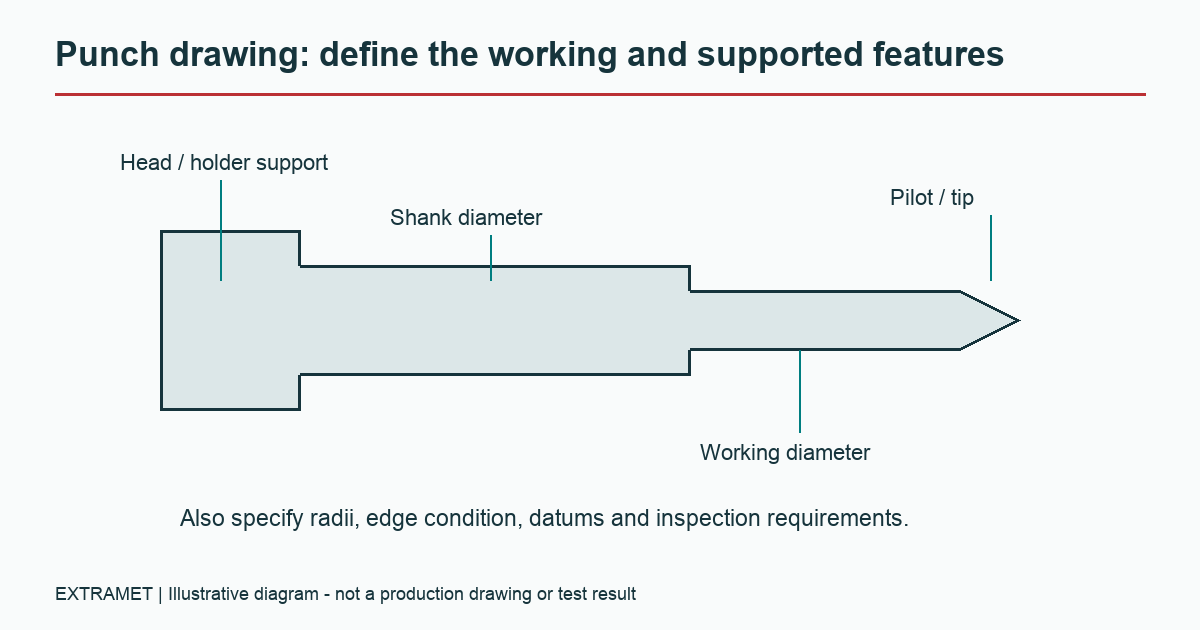
Do not leave support undefined
A carbide punch needs more than a working diameter. Shoulder geometry, holder support, edge prep, and transitions affect breakage risk and service life.
Tip details matter
Pilot ends, straight punches, pierce punches, and forming punches all put different stress on the working end. Include radii, angles, flats, edge condition, and surface finish on the print.
The application guides the material
The punched material, thickness, lubrication, and production volume influence grade choice. A generic carbide grade may not be the best fit for every punch.
Frequently Asked Questions
What is a straight carbide punch?
It is a punch with a straight working body, often used when a consistent diameter or profile is required.
What makes a pilot punch different?
A pilot punch includes a geometry that helps guide or locate the operation before the working feature engages.
Why avoid sharp transitions?
Sharp unsupported transitions can concentrate stress and increase chipping or breakage risk.
For the complete purchase request, use the custom-punch RFQ checklist alongside the controlled drawing.
Use the punch failure checklist to collect evidence about chipping, galling, wear or breakage.
Send the drawing, application and quantity through the RFQ form when the requirements are ready for review.
Product questions? Contact Michael Douglas, Extramet Products product expert and Sales and Marketing contact.