
A custom carbide punch request needs the geometry that does the work and the geometry that supports it. Send the controlled print together with the present wear or failure history so material and design can be reviewed together.
For a quotation, use the carbide punch requirements with the complete tool drawing.
Build a punch-specific RFQ package
| Drawing or application detail | Why it changes the review |
|---|---|
| Working profile and length | Defines contact and unsupported projection |
| Shank, head and holder fit | Shows support and assembly conditions |
| Radii, chamfers and edge condition | Identifies transitions and edge requirements |
| Work material and operation | Distinguishes piercing, forming and locating duty |
| Failure evidence | Separates progressive wear from chipping or breakage |
| Inspection and quantity | Establishes acceptance and production scope |
Explain the failure in one useful paragraph
An illustrative note might read: “The existing punch develops chips at the working edge after a variable number of strokes. Drawing revision D is attached, along with the work material, holder arrangement and photographs showing the contact side. Please review grade and geometry before quoting a replacement.” This is a fictional format, not a diagnosed case.
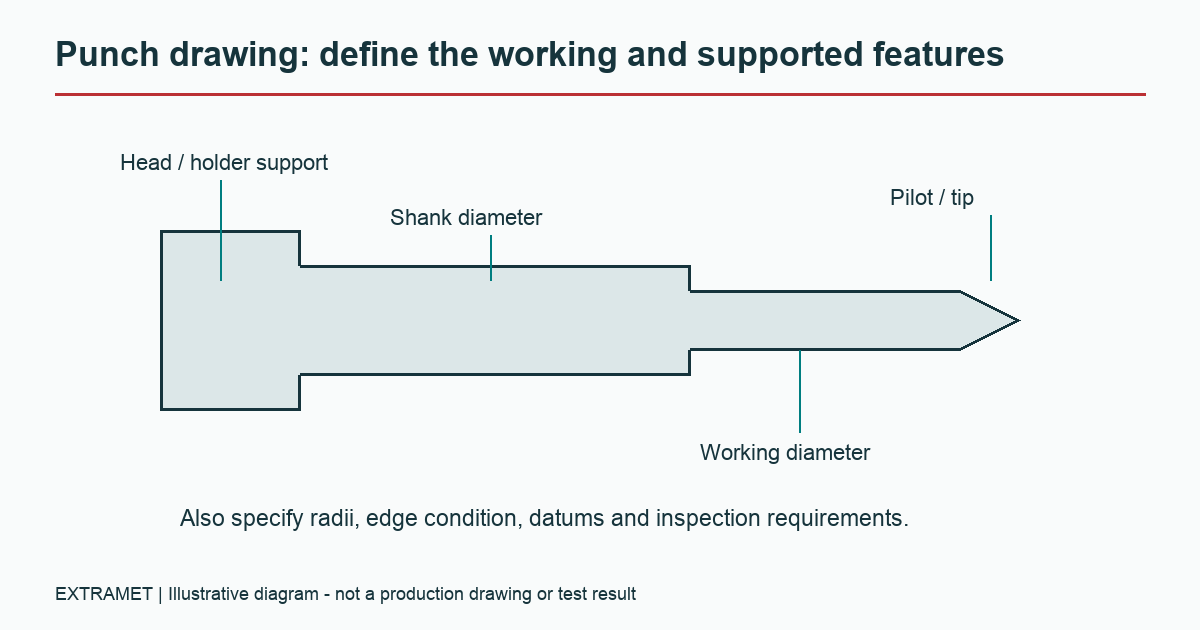
The schematic below identifies information to include; it is not a production drawing or a recommended punch design. Provide actual dimensions, tolerances, datums and clearance requirements on the controlled print.
Use the fillable RFQ worksheet for the order details, then attach the punch print and any inspection record.
Start with the wear mode
Most punch problems are not just material problems. They are system problems. A punch may fail because of abrasive wear, edge chipping, galling, impact loading, misalignment, poor lubrication, or a mismatch between punch and die clearance. Tungsten carbide can help, but different carbide grades respond differently to abrasion and impact.
If the existing steel punch wears gradually, a harder carbide grade may improve life. If the punch chips or fractures, toughness and edge design may matter more than maximum hardness. The application should guide the material decision.
Specify grade or performance requirement
If you know the required grade, include it. If you do not, describe the material being punched, production volume, impact conditions, lubrication, and failure history. Extramet’s tungsten carbide grades information can help frame the conversation around hardness, toughness, binder content, and wear resistance.
Grade selection is one reason carbide punches should not be bought only by dimensions. Two punches with the same print can behave differently if the grade is wrong for the application.
Define geometry and edge condition clearly
For custom punches, include diameter, length, working end geometry, head or shank details, radii, chamfers, flats, relief, and any special features. Edge condition is especially important. A sharp edge may cut cleanly but chip sooner in the wrong environment. A controlled radius or chamfer may improve durability depending on the operation.
When the punch requires precision features beyond simple grinding, review Extramet’s tungsten carbide machining capabilities so the manufacturing path can be chosen early.
Include tolerance and inspection needs
Dimensional requirements should be tied to the application. Diameter, straightness, concentricity, surface finish, and working length may all matter. If a tolerance is critical to fit or tool performance, call it out. If a tolerance is inherited from an old print but not actually functional, say so. That can affect cost and lead time.
Use performance data when available
If the current punch lasts 20,000 hits before edge wear or 5,000 hits before fracture, include that information. If the goal is longer maintenance intervals, better dimensional consistency, or less downtime, note that too. Buyers can also use Extramet’s tungsten carbide wear life estimator to think through the performance side before requesting a quote.
For the fastest review, send the drawing, material requirement, quantity, current failure mode, and operating context through the Request for Quote form.
The straight and pilot punch drawing guide identifies working, locating and supporting features to specify.
Use the punch failure checklist to collect evidence about chipping, galling, wear or breakage.
Product questions? Contact Michael Douglas, Extramet Products product expert and Sales and Marketing contact.