
Chipping, galling, gradual wear and complete breakage call for different checks. Preserve the failed punch and its operating history before changing the carbide grade or ordering an identical replacement.
For a quotation, use the carbide punch requirements with the complete tool drawing.
A symptom-to-investigation checklist
| Symptom | Possible contributors, not a diagnosis | Check next |
|---|---|---|
| Edge chipping | Impact, clearance, alignment, support or edge condition | Inspect the edge and verify holder and mating-tool alignment |
| Galling or adhered material | Contact conditions, lubrication or surface condition | Identify transferred material and review lubrication |
| Progressive dimensional wear | Abrasive contact, load or unsuitable material balance | Measure wear by location and service interval |
| Sudden breakage | Bending, assembly stress, overload or pre-existing damage | Locate fracture origin and review load and assembly history |
Collect evidence before cleanup
Photograph the part in orientation, label the working end and retain any fragments. Record drawing revision, grade if known, work material, cycle count, lubrication changes and the last acceptable inspection. Cleaning away transferred material can remove useful evidence, so agree on the examination process first.
A damaged edge may be the consequence of another problem, such as wear changing clearance. A harder replacement is not automatically the next step. Review holder support and mating-tool condition along with material selection.
Define the next trial
State what will change and how success will be measured. Track both finished-part quality and punch condition. The diagram is a visual checklist, not a micrograph or proof of a failure mechanism.
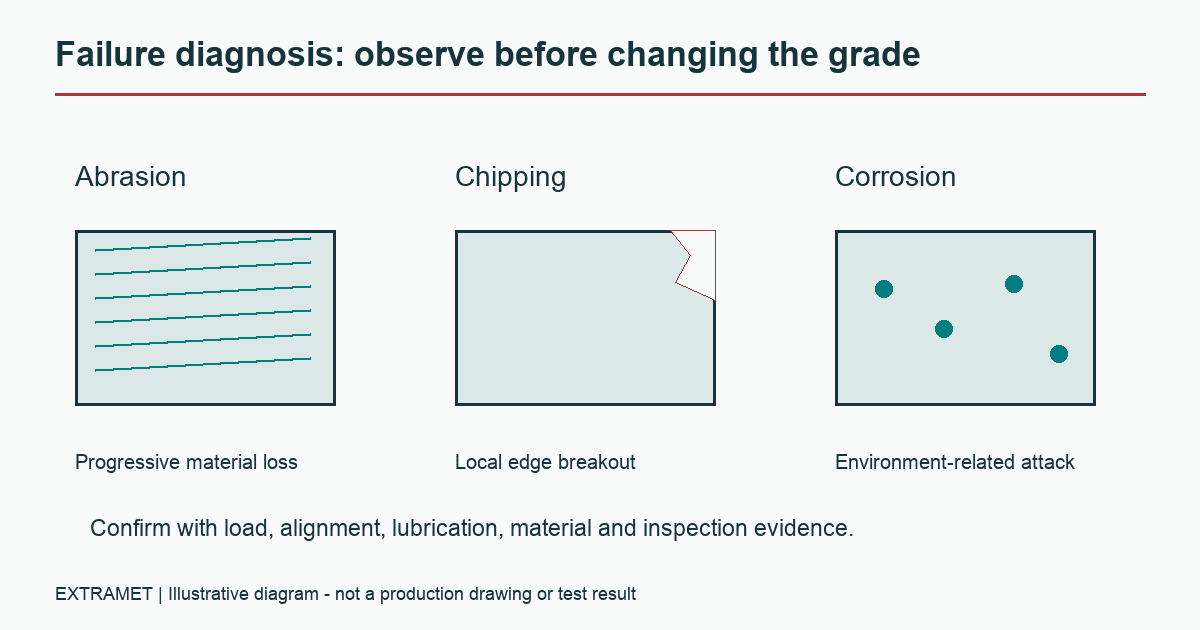
Failure diagnosis beats guessing
A carbide punch that chips needs a different response than one that wears slowly. Before changing grade, inspect the failure surface, alignment, clearance, material being punched, and support around the working edge.
Why carbide is sensitive to support
Carbide is hard and wear resistant, but it does not tolerate unsupported impact the way steel can. Proper holder design, shoulder support, edge prep, and clearance help protect the punch.
Use the failure mode in the RFQ
Photos and process notes are useful. They help Extramet understand whether the punch needs a tougher grade, a wear-resistant grade, a geometry change, or a different finishing approach.
Frequently Asked Questions
Why did my carbide punch chip?
Chipping can come from impact, side load, poor edge support, clearance issues, or a grade that is too brittle for the application.
Can a tougher grade solve breakage?
Sometimes, but alignment, support, and geometry should be checked first.
Does surface finish affect galling?
Yes. Finish, lubrication, clearance, and contacted material all influence galling.
The straight and pilot punch drawing guide identifies working, locating and supporting features to specify.
Review punch and die grade selection when the two components show different damage or loading conditions.
Send the drawing, application and quantity through the RFQ form when the requirements are ready for review.
Product questions? Contact Michael Douglas, Extramet Products product expert and Sales and Marketing contact.