
Stepped carbide parts need a drawing that relates each diameter, shoulder and taper to the functional reference geometry. Wheel access and inspection access should be reviewed before the print is released for grinding.
Review the CNC cylindrical grinding service for the full geometry and datum requirements.
Call out relationships, not just individual sizes
| Feature | What to identify |
|---|---|
| Multiple ODs | Diameter limits and the required relationship between axes |
| Shoulder face | Axial location, face requirement and datum role if applicable |
| Transition | Permitted radius, relief or undercut |
| Taper | Angle or size relationship, length and reference |
| Inspection | Accessible surfaces and the agreed datum setup |
Check the corner that the wheel must reach
A sharp shoulder on a sketch can conceal a limited-radius requirement or a need for relief. Show the mating component constraint where it controls the permissible transition. Do not assume a zero-radius internal corner is available through ordinary grinding.
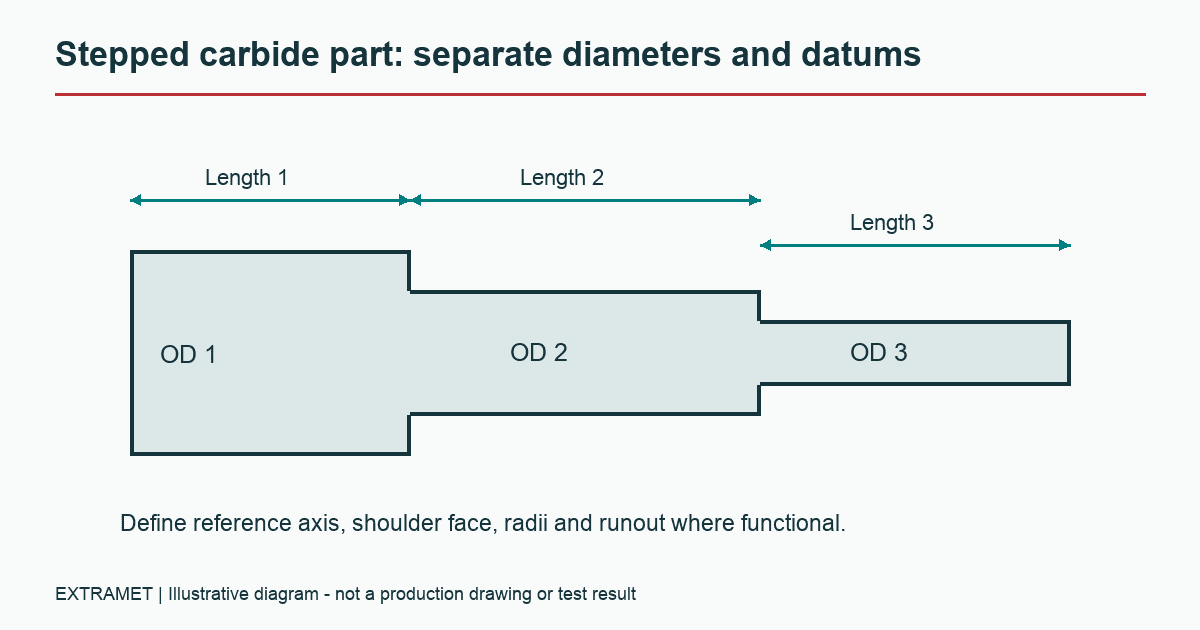
For an illustrative three-diameter part, assign length and diameter limits to each section, then state which axis and shoulder establish the functional reference. Three individually acceptable diameters do not automatically establish an acceptable relationship between them.
Review starting stock and acceptance together
Send the proposed material condition and final print. The process review should consider stock for cleanup, holding features, sequence and inspection access. The diagram below is not dimensioned for manufacture; it identifies the information to add to a controlled drawing.
When centerless is not enough
Centerless grinding is excellent for simple cylinders, but shouldered, stepped, or tapered carbide parts often need cylindrical grinding to control feature relationships.
Datum clarity prevents confusion
If the part has multiple diameters or functional faces, the print should state datums, concentricity needs, shoulder radii, and which dimensions are critical.
Edge protection
Carbide features can chip if edges are unsupported or too sharp. Radii, chamfers, and process notes help protect working geometry.
Frequently Asked Questions
Can centerless grinding make shoulders?
Centerless is limited for shoulders and complex profiles. Cylindrical grinding is usually better for those features.
Why specify shoulder radius?
A proper radius can reduce stress concentration and chipping risk.
Can tapers be ground in carbide?
Yes, when geometry, setup, and inspection requirements are defined clearly.
Compare centerless and cylindrical workholding when geometry or datum relationships control the route.
Check the grind-allowance example when starting dimensions and finished dimensions are different.
Send the drawing, application and quantity through the RFQ form when the requirements are ready for review.
Product questions? Contact Michael Douglas, Extramet Products product expert and Sales and Marketing contact.