
Grind allowance is intentional extra material between the supplied blank and the finished drawing. Agree on the supplied condition and the finishing route before selecting an allowance; a single standard amount does not suit every carbide part.
Use the carbide blank requirements to define the starting material and supplied condition.
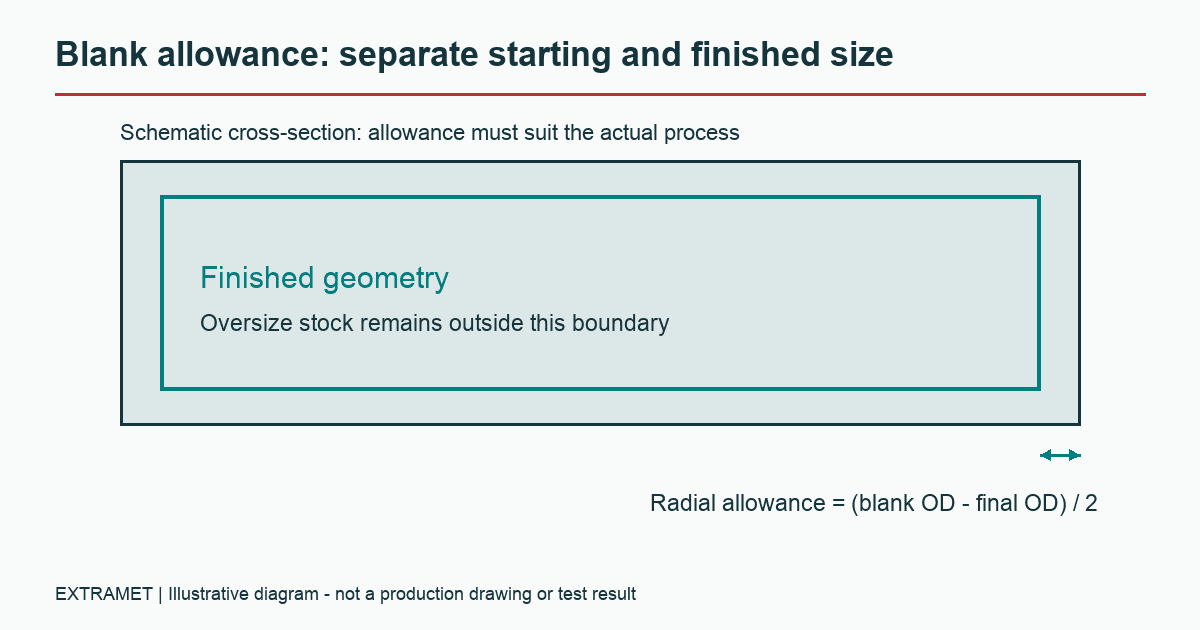
Radial and diametral allowance are different
Illustrative example: a blank with a 0.520 inch OD is intended for a 0.500 inch finished OD. Diametral allowance is 0.020 inch; radial allowance is 0.010 inch per side. Calling both values simply allowance creates a two-to-one ambiguity.
| Drawing item | Illustrative value | What it controls |
|---|---|---|
| Finished OD | 0.500 in, tolerance specified separately | Final acceptance |
| Starting blank OD | 0.520 in | Material supplied |
| Diametral allowance | 0.020 in | Total OD reduction |
| Radial allowance | 0.010 in | Stock per side |
The example explains arithmetic only. It does not recommend 0.010 inch per side for your part. Bow, ovality, surface condition, length, setup, grade and the amount needed to clean up the entire surface can change the required stock.
Resolve these notes before ordering
State the minimum and maximum starting dimensions, which surfaces will be ground, and who is responsible for final inspection. Separate end allowance from OD allowance. If a downstream shop owns final grinding, have that shop accept the blank specification before purchase.
Start with the finished component
Custom blanks should be built backward from the finished part. The drawing should make clear which features are final, which are oversize, and which will be ground after sintering or stock preparation.
Grade and grind allowance work together
A very wear-resistant grade can be harder to finish. A tougher grade may be selected for impact or chipping risk. The blank size should leave enough material for cleanup without adding unnecessary grinding time.
How to avoid quote delays
The fastest carbide blank quotes usually include a print, target grade, quantity, tolerance, finish, and a note on where the blank will be finished. If the print is still in design, send the application requirements too.
Frequently Asked Questions
What is grind allowance?
Grind allowance is extra material left on the blank so the final surface can be ground to size and finish.
Can a blank be too oversized?
Yes. Too much oversize adds grinding time, cost, and material use without improving the final part.
Should I specify grade before geometry?
Specify both together when possible. Grade can affect manufacturability, edge condition, and finishing strategy.
The near-net versus finish-ground comparison explains who should own the remaining operations and final acceptance.
The tool-blank drawing guide separates size limits, straightness, end condition and surface finish.
Send the drawing, application and quantity through the RFQ form when the requirements are ready for review.
Product questions? Contact Michael Douglas, Extramet Products product expert and Sales and Marketing contact.