
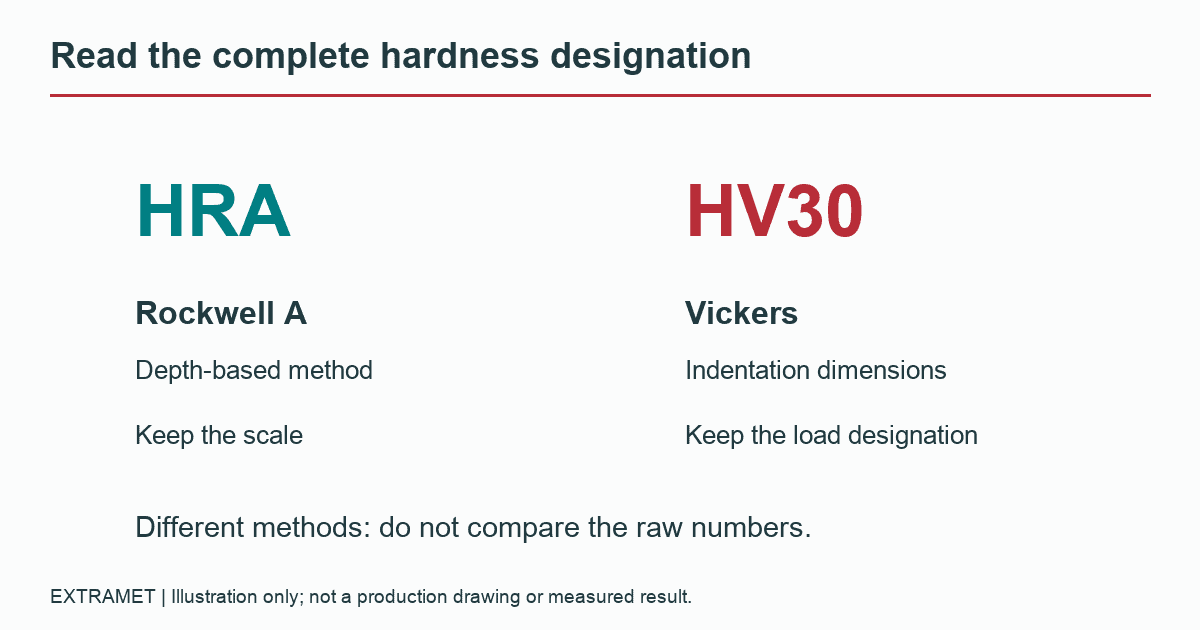
HRA and HV30 are hardness designations, not interchangeable units. HRA identifies the Rockwell A scale; HV30 identifies a Vickers hardness result using the specified 30 kgf test-force designation. Compare the method and reporting basis before comparing the numbers.
When reviewing carbide grade data, retain the full scale designation from the supplier’s document. Removing the letters to make a spreadsheet look cleaner can remove the information that makes the value meaningful.
What the two methods measure
Both methods use an indentation to assess resistance to penetration, but they do not determine hardness in the same way. Rockwell A uses a diamond cone and a depth-based measurement under its prescribed loading sequence. Vickers uses a diamond pyramid and the dimensions of the resulting indentation together with the applied force.
The “30” in HV30 is a test-force designation, not a claim that the material is thirty units harder than another carbide. HV10 and HV30 should not be treated as identical labels. Use the actual test method, load and reporting conditions when evaluating a comparison.
Keep a supplier comparison on a consistent basis
| Record this | Why it matters |
|---|---|
| Grade and document revision | The quoted material and the data sheet must refer to the intended formulation. |
| Complete hardness designation | HRA, HV10 and HV30 should remain identifiable. |
| Typical value or specified range | A representative catalog value is not automatically a lot acceptance limit. |
| Test method and sample basis | Different specimen or reporting conditions can affect comparability. |
| Lot-specific evidence, if required | The purchase order should define whether an actual test report is needed. |
For an illustrative comparison, Supplier A lists a typical hardness of 92 HRA, while Supplier B lists 1,600 HV30. Those two entries alone do not establish which grade meets a particular drawing, nor do they prove that the grades are equivalent. They first tell the buyer that the measurement scales differ.
The next step is to obtain comparable data or an agreed, applicable conversion basis, not to rank the two raw numbers. Where acceptance is specified on one scale, ask how compliance with that requirement will be demonstrated.
Why a conversion is not a grade cross-reference
A hardness conversion can be an approximation with a defined material and method scope. Do not apply a steel conversion chart to cemented carbide merely because the scale labels appear familiar. Even a suitable comparison of hardness does not establish the same composition, grain structure, corrosion behavior or fracture resistance.
The carbide property overview places hardness alongside other properties. A wear component that chips under load needs more than a search for the highest hardness entry.
Separate catalog data from acceptance evidence
A catalog usually helps narrow the material discussion. An order requirement defines what must be supplied. A test report documents an observation under stated conditions. A certificate of conformity may declare compliance without containing every measured result. Confirm which document the customer actually requires.
The material-certificate and inspection-report guide explains those document roles. Before purchase, agree on the hardness scale, test standard, sampling or lot basis, and any required reporting of individual results. Do not infer that every finished part has been indentation-tested.
Download the fillable hardness-data comparison worksheet (PDF).
A useful question for a proposed substitution
Ask: “Can you show how the proposed grade meets our hardness requirement using the specified method, and identify the other properties that differ from the current grade?” Attach the current drawing and material requirement. That produces a more useful response than asking whether two different catalog numbers are close enough.
Hardness comparison questions
Does a higher hardness value mean a better carbide?
Only compare values on a suitable common basis, and then consider the application. Hardness alone does not determine resistance to chipping, corrosion or failure in an assembly.
Can a typical data-sheet value be used as a purchase limit?
Not automatically. Agree on the acceptance requirement with the supplier and state it in the controlled purchasing documents.
Technical references
Questions about the supplied carbide part? Contact Michael Douglas, Extramet Products product expert, or send the drawing and requirements for review. Application-specific approval belongs with the responsible technical and quality reviewers.