Read a carbide porosity rating together with the test method, specimen identity and acceptance requirement. A compact rating on its own is not a complete material specification, a percentage of void volume or proof that a finished component will meet its service-life target.
When ordering carbide blanks with defined material requirements, state whether a porosity report is required and identify the governing specification. Confirm availability, scope and cost of the requested evidence before placing the order.
Start by identifying what was evaluated
ASTM B276 addresses the metallographic determination of apparent porosity in cemented carbides. Its public scope uses apparent porosity broadly: the observed microstructure can include uncombined carbon or nonmetallic inclusions as well as actual voids. A label saying “porosity” therefore needs the method’s definitions, not an assumption that every indication represents the same feature.
The method is distinct from the purchasing specification. A customer and producer may reference a method when defining acceptable levels, but a report citing the method does not, by itself, tell the buyer which level the order required.
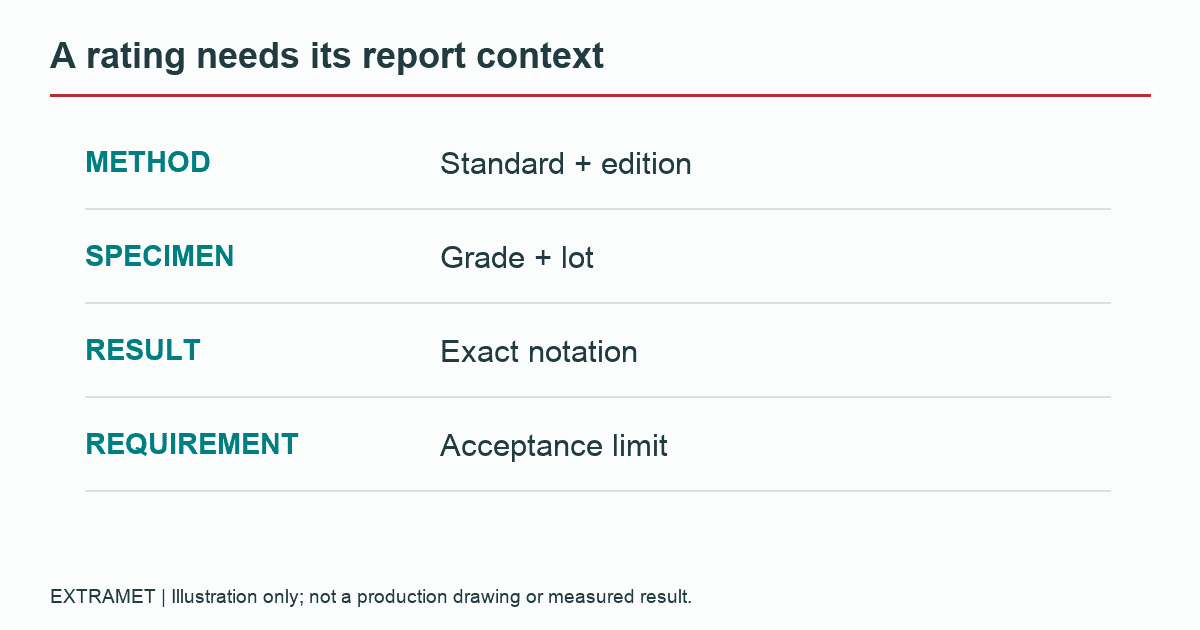
Read the report in a fixed sequence
| Step | What to find | If it is missing |
|---|---|---|
| 1. Identify | Grade, lot, specimen and report reference | Ask how the result connects to the material supplied. |
| 2. Establish the method | Standard designation and edition | Resolve which definitions and procedure apply. |
| 3. Read the result | The exact reported notation and categories | Request the applicable interpretation; do not guess a percentage. |
| 4. Find the requirement | Acceptance limit and controlling document | Do not decide pass/fail from the result alone. |
| 5. Review the disposition | Comparison with the agreed requirement | Resolve exceptions before accepting the material. |
For an illustrative purchasing situation, a report contains a rating but the order only says “standard quality.” The buyer cannot reconstruct a contractual acceptance limit from that phrase. The useful next action is to resolve the specification and its intended application with the supplier, not to assume that the most stringent rating found online was included.
Be careful with letter-and-number shorthand
Some carbide documents use compact A-, B- and C-category notation. Preserve the full notation and identify the standard used to assign it. The category definitions, comparison basis and meaning of the numbers must come from that method; do not read them as interchangeable grades or as direct percentages.
A rating copied from another producer’s catalog is not an Extramet guarantee. Nor does a report establish the manufacturing route unless that information is separately documented. This guide does not assign a porosity class to Extramet material or claim an in-house test capability.
Understand the specimen and sampling basis
Ask whether the report describes a particular specimen, a qualification sample or material associated with the supplied lot. Clarify how it is representative of the order and what the purchase agreement requires. Do not assume that every shipped component was sectioned or individually examined.
The material-report guide distinguishes material evidence from dimensional inspection. A porosity report does not replace the checks required for a finished diameter, face or surface finish.
Download the fillable porosity-report review worksheet (PDF).
Use current, agreed references
Include the edition of the required method and the revision of the acceptance specification. Standards can be revised, and a proposed revision is not the same as a published replacement. The public ASTM listing identifies B276-21; confirm the edition applicable to the order when the requirement is finalized.
Older reports may reference ISO 4505:1978, which ISO lists as withdrawn and replaced by ISO 4499-4:2016. The replacement addresses porosity, carbon defects and eta-phase content. Confirm the applicable edition rather than copying a legacy reference into a new order. Do not substitute methods or ratings without agreement, and obtain the standard through an authorized source rather than using an unlabeled comparison chart.
Finally, connect material acceptance to the broader carbide grade requirements. Porosity is one part of a material review, not a substitute for the grade, dimensions and application conditions.
Material report questions
Is a porosity rating a percentage?
Do not interpret it that way without the governing method. Preserve the reported notation and use that method’s definitions.
Does a satisfactory rating guarantee wear life?
No. Material acceptance and application performance are different questions; geometry, loading, environment and other properties still matter.
Technical references
Questions about the supplied carbide part? Contact Michael Douglas, Extramet Products product expert, or send the drawing and requirements for review. Application-specific approval belongs with the responsible technical and quality reviewers.