
Carbide pins can locate, guide or form, but those functions place different demands on support, fit and contact surfaces. Start by describing what the pin does in the assembly before specifying a grade or finish.
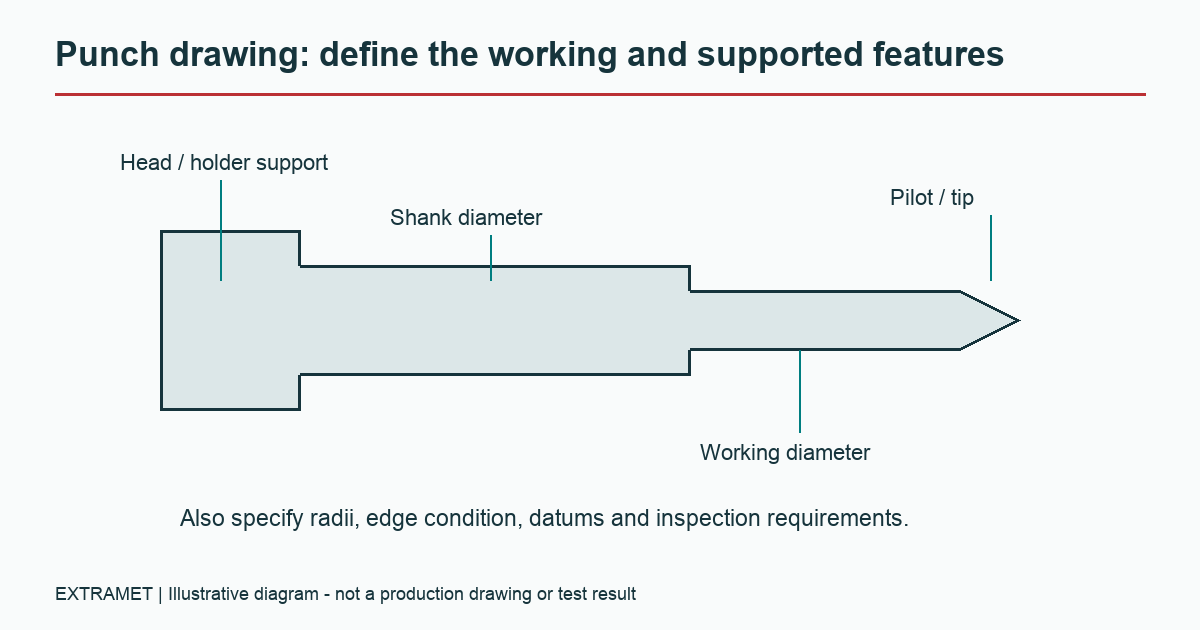
Use the carbide pin requirements to define the working and supported features.
Three application scenarios
| Pin function | Illustrative use | Specification questions |
|---|---|---|
| Locating | Repeatedly positioning a mating component | What locates on the pin, what clearance is intended, and what supports it? |
| Guiding | Sliding contact that must maintain alignment | Where does wear occur, what is lubricated, and what finish is functional? |
| Forming | Applying contact load to shape material | What is the working profile, contact load and transition geometry? |
Separate the contact zone from the supported zone
A guide pin may need a controlled sliding surface and a different mounting fit. Mark those zones on the drawing. An OD value alone does not describe the shoulder, end condition, concentric relationship or allowable surface roughness.
If a locating pin loses size gradually, record wear at the actual contact zone. If it breaks near the holder, document the unsupported length, assembly fit and side loading. These observations guide investigation; they do not prove the grade was wrong.
Include the mating-part context
Send the mating material and relevant assembly geometry with the pin print. Explain installation, lubrication and inspection access. For a replacement project, record the current service interval and rejection limit before trialing a new material.
Why pins move from steel to carbide
Steel pins can lose diameter, mushroom, gall, or wear unevenly under abrasive contact. Carbide pins are selected when the cost of wear, downtime, or dimensional drift exceeds the cost of the carbide component.
Grinding and finish matter
Many carbide pins depend on precise outside diameter, roundness, and finish. Centerless grinding is often a strong fit for simple cylindrical pins, while cylindrical grinding may be preferred for shoulders, steps, or datum-related geometry.
Grade selection for pins
A pin that sees steady abrasion may use a harder wear-resistant grade. A pin exposed to shock, side loading, or edge chipping may need more toughness. The application should guide the grade choice.
Frequently Asked Questions
Are carbide pins brittle?
They are more brittle than steel, so support, alignment, grade, and edge geometry matter.
Can carbide pins be polished?
Yes. Finish requirements should be specified with the diameter tolerance and application details.
Can Extramet grind pins from customer material?
Extramet can review customer-supplied material for grinding depending on grade, condition, and geometry.
Plan a controlled replacement using the steel-to-carbide trial checklist rather than assuming the upgrade will pay for itself.
The OD tolerance and inspection guide distinguishes diameter limits from form and measurement requirements.
Send the drawing, application and quantity through the RFQ form when the requirements are ready for review.
Product questions? Contact Michael Douglas, Extramet Products product expert and Sales and Marketing contact.