
Fine, submicron and coarse describe carbide grain structure, but the labels must be read using the supplier’s definitions. A smaller-sounding label is not automatically the best material for the part.
Compare the documented carbide grades with the application before approving material.
Start with a documented grain-size description
Ask whether the data sheet gives a measured size, a size range or a category name, and how it was determined. Compare labels only after checking that their definitions match. Do not assign a universal numerical boundary to every supplier’s fine or coarse category.
Grain size does not act alone
Binder content, chemistry and other formulation choices interact with grain structure. Compare actual grade data on a consistent test basis. A difference in hardness between two products cannot automatically be attributed only to grain size.
For supplier terminology, consult the Hyperion WC-Co grade overview. Its categories describe that supplier’s material system, not a universal equivalency table for Extramet grades.
| Question | What a useful answer includes |
|---|---|
| What does the grain label mean? | Supplier definition, range or measured basis |
| Is the binder comparable? | Composition and relevant formulation differences |
| Which properties were measured? | Hardness, strength or toughness with test methods |
| Does the application support the choice? | Edge size, contact, impact and finishing requirements |
Two named grades from the published Extramet overview
| Published overview value | EMT 409 | EMT 609 |
|---|---|---|
| Category in that document | Fine grain | Ultrafine grain |
| Average grain size | Approximately 1.2 micrometers | Approximately 0.5 micrometers |
| Cobalt | 9% | 9% |
| Other carbides | 1% | 1.5% |
| Hardness, HV30 / ISO 3878 | 1,550 +/- 60 | 1,880 +/- 80 |
The Extramet grade overview, marked July 2022, supplies these typical material values. The two grades share the listed cobalt percentage but differ in other carbides as well as grain size. This is not a controlled grain-size experiment, an equivalency statement or a current purchase specification. Confirm the applicable data sheet with Extramet.
A fine edge and an impact-loaded part ask different questions
For a small cutting edge, discuss edge geometry, work material, interrupted contact, grinding and any coating route. For an impact-loaded wear component, document support, load direction and fracture history. These scenarios may lead to different material discussions, but neither permits selecting a grade from grain terminology alone.
If two candidate grades differ in both binder and grain structure, do not present a trial as a single-variable grain-size test. Record the full material designation and every intentional geometry or process change.
What an image can and cannot prove
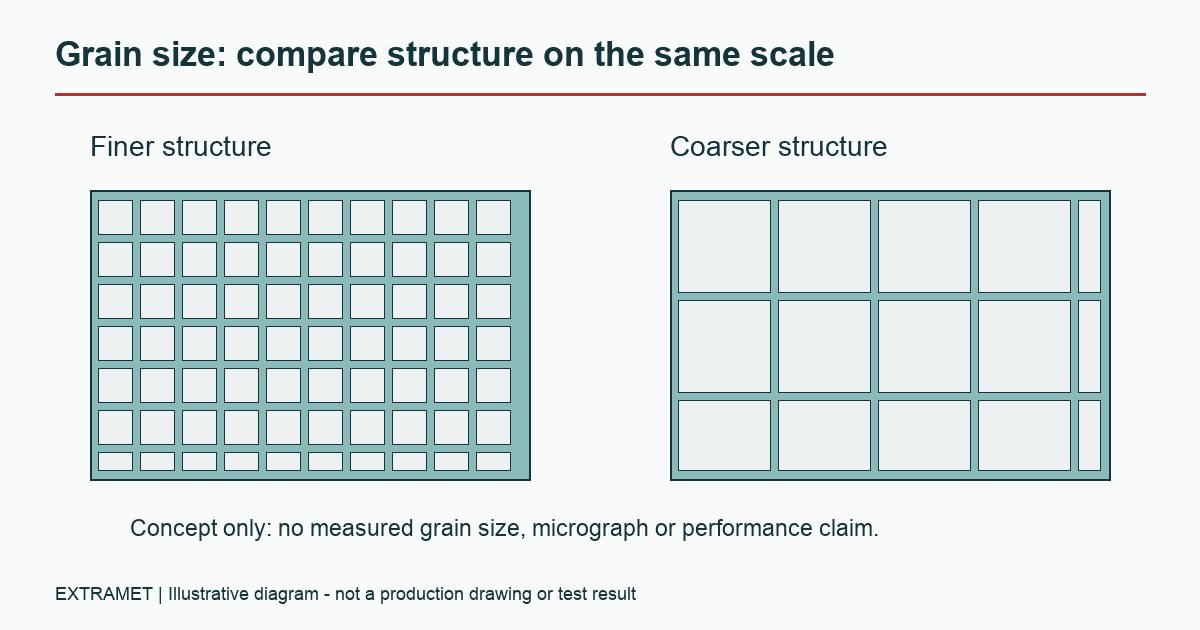
A real micrograph needs an identified material, a scale bar and a stated preparation or imaging basis to support size interpretation. The diagram in this article is only a visual explanation of relatively finer and coarser structures. It is not a micrograph, measured distribution or representation of a particular Extramet grade.
Make the specification repeatable
Order by the approved grade designation, retain the relevant data sheet and require approval for substitutions. Include the application and finishing requirements when the grade is still open. That is more reliable than ordering a generic fine-grain carbide and expecting an identical result from different material systems.
Use the grade-selection workflow to connect the application evidence with a documented material choice.
Read the cobalt binder explanation before treating a percentage as a complete grade specification.
Send the drawing, application and quantity through the RFQ form when the requirements are ready for review.
Product questions? Contact Michael Douglas, Extramet Products product expert and Sales and Marketing contact.