
Hardness, compressive strength, bending strength and fracture toughness answer different questions. A statement that carbide is stronger than steel is incomplete until the load case, grade and test method are identified.
The broader carbide versus steel comparison covers the overall material tradeoffs.
Ask what kind of strength the part needs
| Property or load | What it describes | What it does not establish |
|---|---|---|
| Hardness | Resistance measured by a specified indentation test | Tolerance of impact or bending |
| Compression | Resistance to a pushing load | Behavior of an unsupported slender feature |
| Flexural strength / TRS | Failure under a specified bending test | A universal allowable design stress |
| Fracture toughness | Resistance to crack extension under a defined test | Wear life in a particular machine |
Why a supported insert and a long pin differ
Imagine a supported insert carrying contact load across a broad face, then a long pin taking the same force at an unsupported tip. The pin develops bending stress and concentrates load near its support. Selecting the same grade for both because a catalog compressive-strength value is high misses the geometry.
Compare grade-specific test data using the same method, specimen condition and units. Do not turn a transverse-rupture-strength value directly into an allowable stress without an appropriate design assessment. Flaws, edge condition and finish also affect how a brittle component fails.
What to send for a meaningful comparison
Provide a drawing showing support, load direction and contact location, along with the present failure pattern. Use the broad material comparison for purchasing context; use these load-case questions to clarify the technical review. No universal carbide-versus-steel strength ratio is used here.
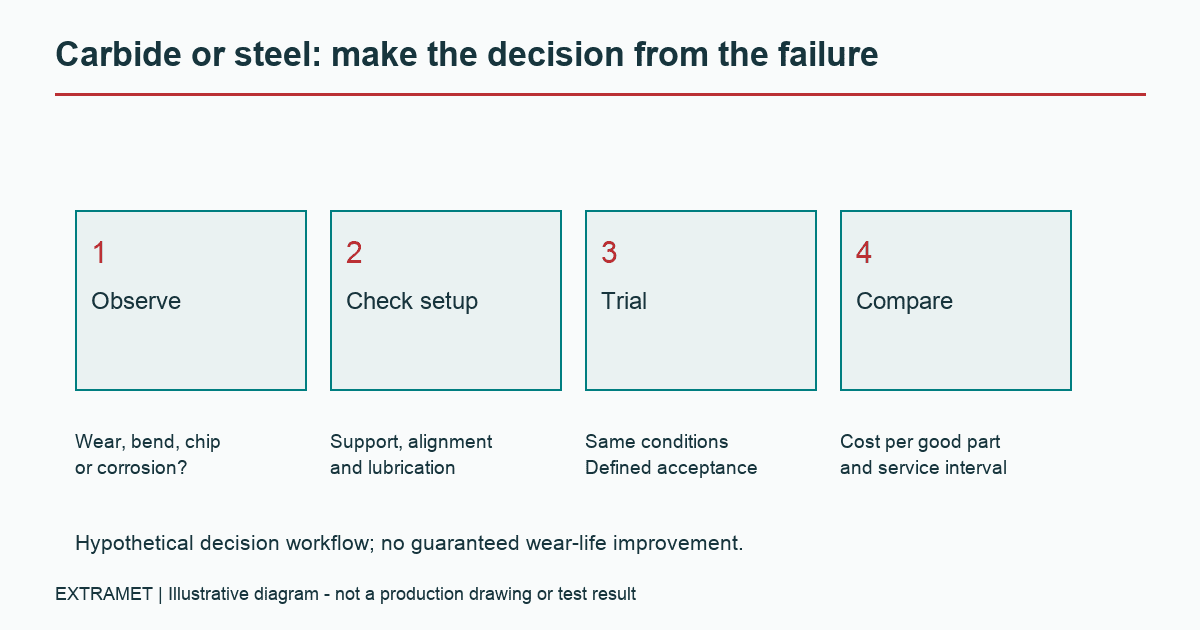
The wear-versus-impact diagnostic guide helps separate progressive loss of material from fracture symptoms.
The carbide properties guide explains which material data to verify before specifying a component.
Send the drawing, application and quantity through the RFQ form when the requirements are ready for review.
Product questions? Contact Michael Douglas, Extramet Products product expert and Sales and Marketing contact.