Select starting stock by how much of it becomes the finished part and how it will be held during finishing. A familiar shape is not necessarily the lowest-cost route once grinding time, offcuts and inspection are included.
Use the carbide blank requirements to define the starting material and supplied condition.
Match stock shape to the finished geometry
| Starting form to discuss | Likely geometry fit | Yield and process question |
|---|---|---|
| Round rod | Pins, cylindrical blanks and round features | How much OD and end stock will be removed? |
| Rectangular or flat blank | Plates, straight wear surfaces and rectangular parts | Can the useful shape fit without excessive offcut? |
| Custom near-net form | Repeated complex geometry | Does reduced finishing justify tooling and order quantity? |
This comparison describes form-selection logic, not a current inventory list. Confirm grade, size and supplied condition with Extramet before specifying a stock item.
A simple yield comparison
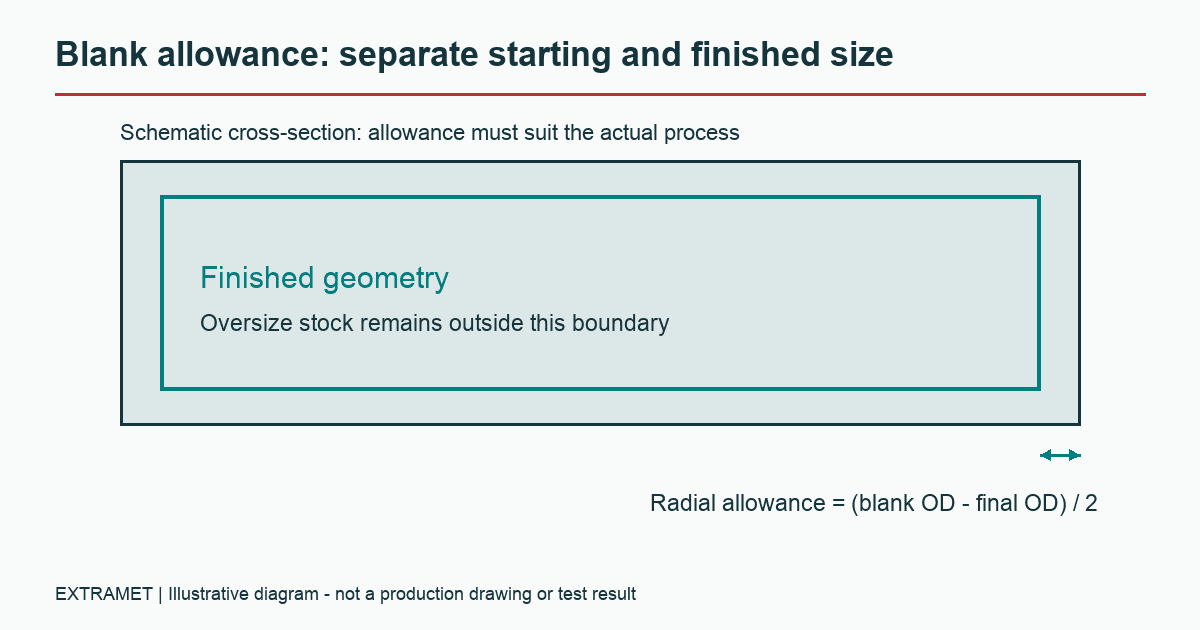
An illustrative 10 x 10 x 50 mm finished rectangle occupies 5 cm3. A 12 x 12 x 55 mm starting rectangle occupies 7.92 cm3, so geometric yield is about 63%. Yield alone is not a quote: fixturing, grinding access and acceptance requirements still matter.
Compare options on the same finished drawing and quantity. A form with less waste may need a longer material lead time or a more expensive setup. Ask the supplier and finishing shop to identify who accepts the starting dimensions.
Why stock form matters
The closer the starting stock is to the finished part, the less material must be removed. That can reduce cost, lead time, and risk, especially when tungsten carbide requires diamond grinding or EDM after sintering.
Round stock for cylindrical parts
Round rods and cylindrical stock are efficient for pins, punches, cutting tool blanks, guide components, and precision OD-ground parts. They pair naturally with centerless grinding and cylindrical grinding.
Rectangular and custom blanks
Flat, rectangular, and near-net blanks make sense when the finished part needs flatness, parallelism, or custom profiles. The best choice depends on tolerance, volume, and downstream finishing steps.
For a shape-specific RFQ, review carbide flat stock and preforms and define thickness, flatness and remaining finishing.
Frequently Asked Questions
Is carbide stock the same as a finished part?
No. Stock is starting material. It may still need grinding, cutting, EDM, inspection, or other finishing.
Which stock form is best for pins?
Round rod stock is usually the starting point for pins because OD precision is the critical feature.
Can stock be selected before grade?
Basic form can be discussed first, but grade should be confirmed before production quoting.
The blank, rod and tool-blank comparison helps turn a general form name into a clearer purchase description.
The near-net versus finish-ground comparison explains who should own the remaining operations and final acceptance.
Send the drawing, application and quantity through the RFQ form when the requirements are ready for review.
Product questions? Contact Michael Douglas, Extramet Products product expert and Sales and Marketing contact.