
Choose between centerless and cylindrical grinding by workholding, reference geometry and the surfaces that must be related to one another. A diameter tolerance by itself is not enough to make the selection.
Review the carbide machining and finishing options against the complete drawing.
Compare how the part is supported and referenced
| Decision | Centerless review | Cylindrical review |
|---|---|---|
| Support | Work-rest and regulating-wheel arrangement | Centers, chuck or another approved holding method |
| Geometry | Feed path, continuous OD and feasible infeed features | Shoulders, multiple ODs and access around features |
| Reference | How required axis relationships are controlled | How the setup relates to specified datums |
| Quantity | Setup suitability and repeat feeding | Setup, indexing and inspection across features |
Centerless grinding is not limited in principle to every part being a plain straight rod; infeed configurations can accommodate some profiles. Whether a particular feature can be made depends on the equipment and setup. Similarly, between-centers grinding is not a substitute for specifying the required datum relationship.
Two drawing-led examples
A long run of simple OD rods may suit a centerless review. A stepped component with a shoulder face and a controlled relationship between multiple diameters may call for cylindrical workholding. These are screening examples, not routing guarantees.
Compare Extramet’s centerless service and CNC cylindrical service using the same print, stock condition and inspection requirements.
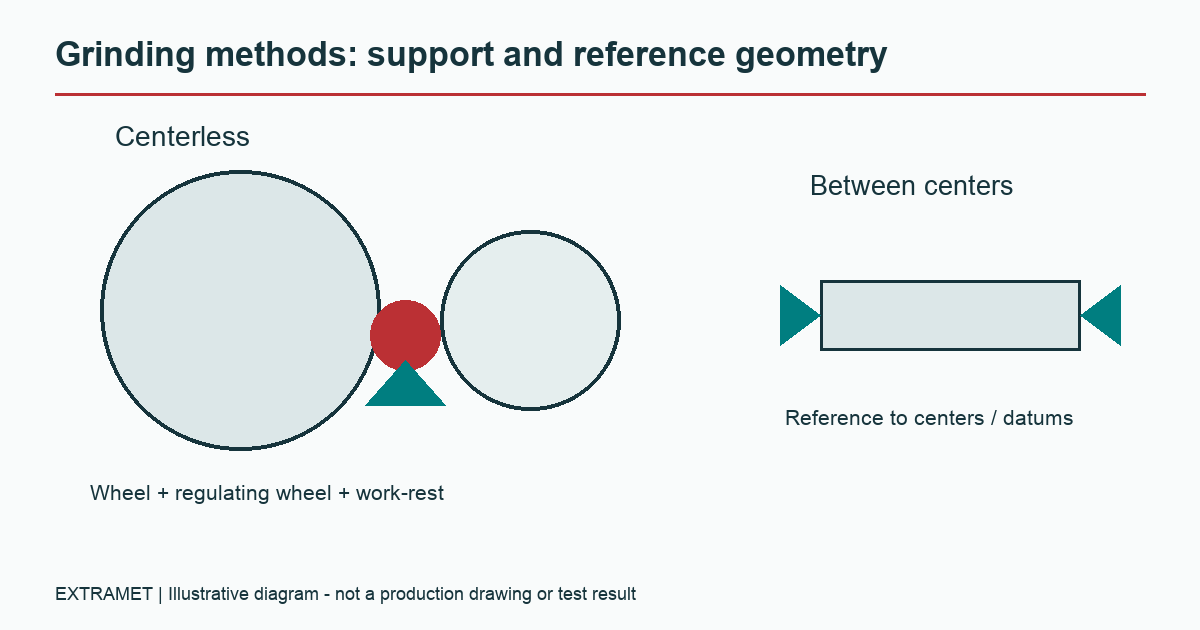
The process choice starts with geometry
If the carbide component is a simple cylinder, centerless grinding can be fast and repeatable. If the component has multiple diameters, shoulders, tapers, or strict datum relationships, cylindrical grinding may be the better process.
Why tungsten carbide changes the conversation
Carbide is hard and brittle compared with steel. Wheel selection, support, coolant, finish, and removal rate all matter. A grinding process that works on steel may not transfer directly to carbide without adjustment.
How to quote grinding correctly
A good grinding RFQ separates starting stock from finished dimensions. It should define material, grade, diameter, length, tolerances, finish, quantity, and inspection requirements.
Frequently Asked Questions
Is centerless grinding faster than cylindrical grinding?
Often, yes, for simple cylindrical parts. Complex geometry may require cylindrical grinding.
Which process is best for carbide pins?
Straight pins often fit centerless grinding. Stepped or shouldered pins may require cylindrical grinding.
Can both processes be used on one project?
Yes. Some carbide projects use more than one grinding method depending on the features and tolerance stack.
For multiple diameters, the shoulders, steps and tapers drawing guide covers datum relationships and wheel access.
The OD tolerance and inspection guide distinguishes diameter limits from form and measurement requirements.
Send the drawing, application and quantity through the RFQ form when the requirements are ready for review.
Product questions? Contact Michael Douglas, Extramet Products product expert and Sales and Marketing contact.