
A carbide punch and its mating die do not automatically need the same grade. Their section thickness, support, contact and failure patterns can differ even when they operate as one tooling set.
For a quotation, use the carbide punch requirements with the complete tool drawing.
Review the pair, then each component
| Illustrative observation | Punch questions | Die questions |
|---|---|---|
| Punch edge chips while the die wears gradually | Check edge support, alignment and shock | Measure wear and the resulting clearance change |
| Die insert cracks while the punch remains stable | Confirm punch alignment and contact | Review insert support, fit and local load concentration |
These are investigation examples, not grade prescriptions. A tougher direction may be considered for a fracture problem only after checking geometry and operating conditions. A wear-resistant direction may be useful for progressive loss, but it still has to tolerate the actual load.
Compare compatible evidence
Provide the work material, operation, tool drawings, clearance requirements, lubrication and observed service life for both components. Request the proposed grade data and its test basis. Matching hardness numbers alone does not establish equivalent performance or a suitable tooling pair.
When a trial changes one component, inspect the other as well. An improvement to the punch can expose a different limit in the die or change how wear develops. Record results against the same finished-part acceptance requirements.
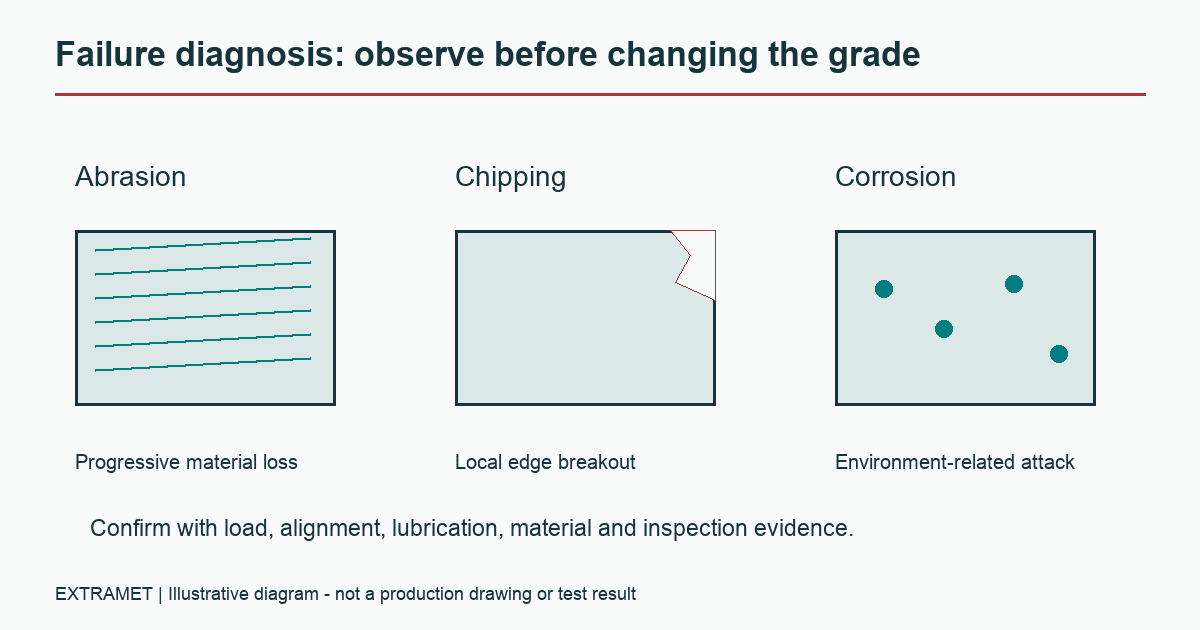
Grade choice follows the job
Punches and dies see concentrated contact, edge stress, and repeated cycles. The grade should match material, clearance, load, lubrication, geometry, and production volume.
Hardness vs toughness
Higher hardness helps wear, but toughness protects against chipping and breakage. Binder content and grain size help tune that balance for the actual tooling environment.
Use failure history
If a current tool wears out, a harder or more wear-resistant grade may help. If it chips or breaks, the answer may be a tougher grade, better support, or geometry changes.
Frequently Asked Questions
What grade is best for carbide punches?
There is no single best grade. It depends on wear, impact, edge support, and material being processed.
Does higher cobalt mean tougher carbide?
Generally, higher cobalt binder can improve toughness, but the full grade formulation matters.
Should dies and punches use the same grade?
Not always. Each component should be selected around its contact stress and failure mode.
Use the punch failure checklist to collect evidence about chipping, galling, wear or breakage.
Use the grade-selection workflow to connect the application evidence with a documented material choice.
Send the drawing, application and quantity through the RFQ form when the requirements are ready for review.
Product questions? Contact Michael Douglas, Extramet Products product expert and Sales and Marketing contact.