
Centerless grinding is worth considering when a carbide rod or pin needs a controlled outside diameter and its geometry can be supported and fed through the selected setup. Qualify the shape and acceptance requirements before selecting the process.
For an OD review, send the drawing and starting condition through the centerless grinding service.
Screen the geometry before requesting a process
| Part condition | Question for process review |
|---|---|
| Simple continuous OD | Can the part be supported and fed consistently? |
| Shoulder, head or interrupted profile | Does the feature prevent through-feed or require an infeed approach? |
| Slender or bowed starting stock | What support and cleanup allowance are needed? |
| Axis relationship to another feature | How will the required datum relationship be established and inspected? |
Through-feed moves suitable work through the wheels; infeed brings the work into the grinding zone without the same axial travel requirement. The existence of an infeed technique does not mean every stepped part is suitable or that every shop offers the required setup.
A useful qualification example
A simple cylindrical rod with an uninterrupted OD is a different quoting problem from a headed pin with a controlled relationship between its shank and working tip. Send the complete drawing, not only the diameter to be ground, so feed path and support can be evaluated.
State material condition, length, quantity, diameter limits, roundness, straightness and surface finish where specified. If concentric features or shoulders drive the design, compare workholding options with the cylindrical-grinding guide instead of assuming that one process is always more accurate.
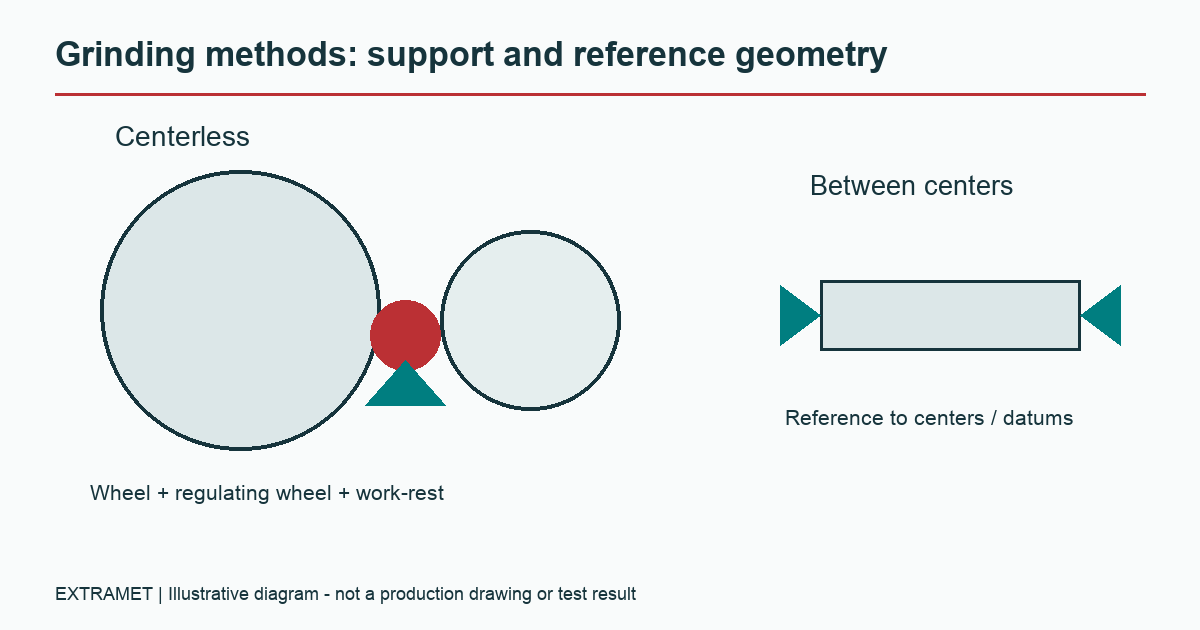
When centerless grinding is a strong fit
Centerless grinding is most useful when the part is round, straight, and repeatable. Common examples include carbide pins, cylindrical blanks, wear sleeves, bushings, rods, and components that need consistent OD control across quantity. Because the workpiece is supported by a blade and controlled between grinding and regulating wheels, the process can be efficient for long runs and parts where OD consistency is the main requirement.
It is also useful when the end use depends on smooth motion, predictable fit, or contact wear. A carbide locating pin, for example, may not need complex milling, but it may need a controlled diameter, clean surface, and stable wear behavior after thousands of cycles.
What to include in the RFQ
For a strong grinding quote, include the carbide grade or performance requirement, starting form, outside diameter, length, tolerance, roundness, straightness, surface finish, quantity, and any inspection notes. If the component sees abrasion, impact, heat, corrosion, or food-contact conditions, include that context too. The application often explains why a tolerance matters and where a different grade or finish may reduce long-term cost.
If the part also needs shaping, holes, slots, or other features, note that early. Tungsten carbide often requires a practical mix of grinding, EDM, lapping, and other precision methods. Extramet’s tungsten carbide machining services page is a useful starting point for parts that go beyond straight OD grinding.
How centerless grinding supports wear life
The value of centerless grinding is not only dimensional accuracy. Better OD control can improve fit, reduce uneven loading, and help the carbide perform the way the grade was selected to perform. A part that is too rough, out of round, or mismatched to its mating component can fail earlier even when the base material is excellent.
For buyers, the practical takeaway is simple: do not treat grinding as an afterthought. The grinding process is part of the performance system. When geometry, grade, finish, and application are aligned, tungsten carbide can deliver the wear resistance it is known for.
For a production review, send the print, material requirement, target quantity, and application notes through Extramet’s Request for Quote form.
Compare centerless and cylindrical workholding when geometry or datum relationships control the route.
The OD tolerance and inspection guide distinguishes diameter limits from form and measurement requirements.
Product questions? Contact Michael Douglas, Extramet Products product expert and Sales and Marketing contact.