
Tungsten carbide and silicon carbide can both serve as hard mechanical seal faces. Common cemented carbide grades contain hard WC grains held by a metallic binder; silicon carbide is a technical ceramic. Choosing between them requires the specific grade, mating face and operating conditions, as well as the ring dimensions.
A seal-face comparison concerns the sliding interface inside an assembly. A tungsten carbide seal ring is one component of that interface. Changing its material can also change how it interacts with the opposite face, the process fluid and the assembly that supports it. A matching outside diameter is only the start of the evaluation.
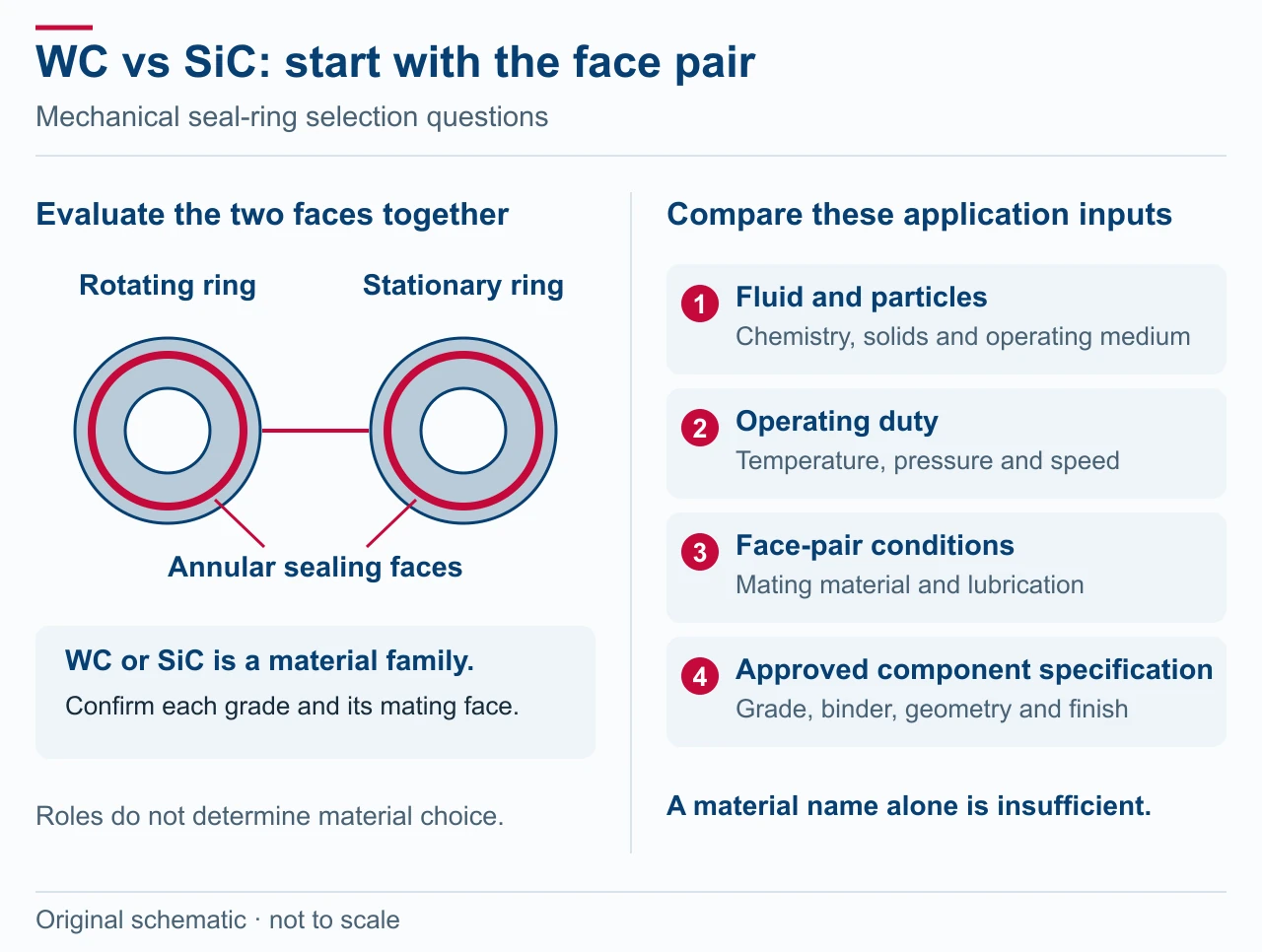
What changes with the material?
In cemented tungsten carbide, the hard grains and the metallic binder perform different jobs. The grains provide the hard, wear-resistant structure, while the binder holds that structure together. Because the binder is part of the exposed material, its chemistry matters when assessing fluid compatibility. Identify the specified grade and binder system in the inquiry.
Silicon carbide also needs a more precise description than its family name. Reaction-bonded and sintered SiC follow different manufacturing routes. A specification should identify which material is intended, including relevant secondary phases or additions. These different material constructions do not establish a universal replacement rule.
Compare the two faces together
A mechanical seal relies on two annular faces, one rotating and one stationary. A thin liquid or gas film lies between them. That is why the comparison is a face-pair decision: the opposite material and the condition of both surfaces belong in the specification.
Keep the component roles clear when reading a drawing. A ring may be associated with the rotating side or the stationary side of the particular design. Its position, support and mating face must come from the assembly information. A material-family label cannot establish interchangeability between complete seals.
Lubrication and heat remain part of the comparison
A hard face still operates as part of a lubricated system. In an oil-lubricated assembly, the oil film separates the faces and helps transfer heat away. A material change does not remove that function or establish that the assembly can run without its intended lubricant.
Describe normal operation and the conditions around starting, stopping or process changes separately. A ring that experiences a steady condition is being evaluated against a different duty description from one exposed to repeated transitions. Record the actual conditions rather than assigning a dry-running or temperature capability from “WC” or “SiC” alone.
Separate the reasons for a material change
A useful comparison identifies the problem before selecting a substitute. Keep three kinds of evidence distinct:
- Wear: describe the process solids, deposits and observed face condition. Photographs and service records are more informative than a general request for a harder ring.
- Chemical exposure: identify the process and cleaning fluids, their relevant concentrations and operating temperatures. Compare the actual carbide binder or SiC grade against that exposure.
- Mechanical condition: preserve the assembly drawing and information about ring support, contact faces and loading. A chipped edge and a progressively worn sliding face do not describe the same problem.
This keeps the evaluation focused. It also makes a subsequent trial easier to interpret because the reason for changing the material has been stated in advance.
Buyer checklist for a carbide seal-ring inquiry
Before comparing tungsten carbide with silicon carbide, collect the details that describe the ring and its face pair. Neither family is a universal replacement for the other.
- Carbide ring requirement and the mating face material
- Process fluid, cleaning fluids and any solids
- Temperature, pressure and speed, including start-up and shutdown
- Specified grade and binder system
- Face finish and flatness requirements
- Rotating or stationary role in the assembly
- Blank or finished ring scope
These details describe one component. The assembly design remains the reference for fit and function.
Keep material and finish requirements separate
Material selection does not replace the drawing’s face requirements. Flatness describes surface form; surface finish describes another part of the surface specification. Mark the functional face and retain the specified inspection requirements. The existing guide to surface finish on carbide components explains that distinction in more detail.
For a carbide-ring inquiry, share the drawing if available, the mating material and a short description of the duty or proposed change. Extramet reviews the requested component scope and supplied condition. Start with the application information you have.