
A carbide wear-part upgrade should earn its additional cost through measured production performance. Compare cost per acceptable part or service interval, including replacement labor and downtime, rather than material price alone.
For a component review, see Extramet’s carbide wear parts and describe the current failure.
A transparent, hypothetical cost comparison
| Assumed trial inputs | Steel baseline | Carbide candidate |
|---|---|---|
| Replacement component | USD 40 | USD 160 |
| Changeover cost | USD 60 | USD 60 |
| Good parts per service interval | 10,000 | 40,000 |
| Cost per good part | USD 0.0100 | USD 0.0055 |
These invented inputs demonstrate the calculation; they are not an Extramet test or a promised fourfold wear-life gain. Divide component plus changeover cost by good parts produced. At these assumptions, the carbide candidate breaks even at 22,000 good parts per interval, before considering any other costs.
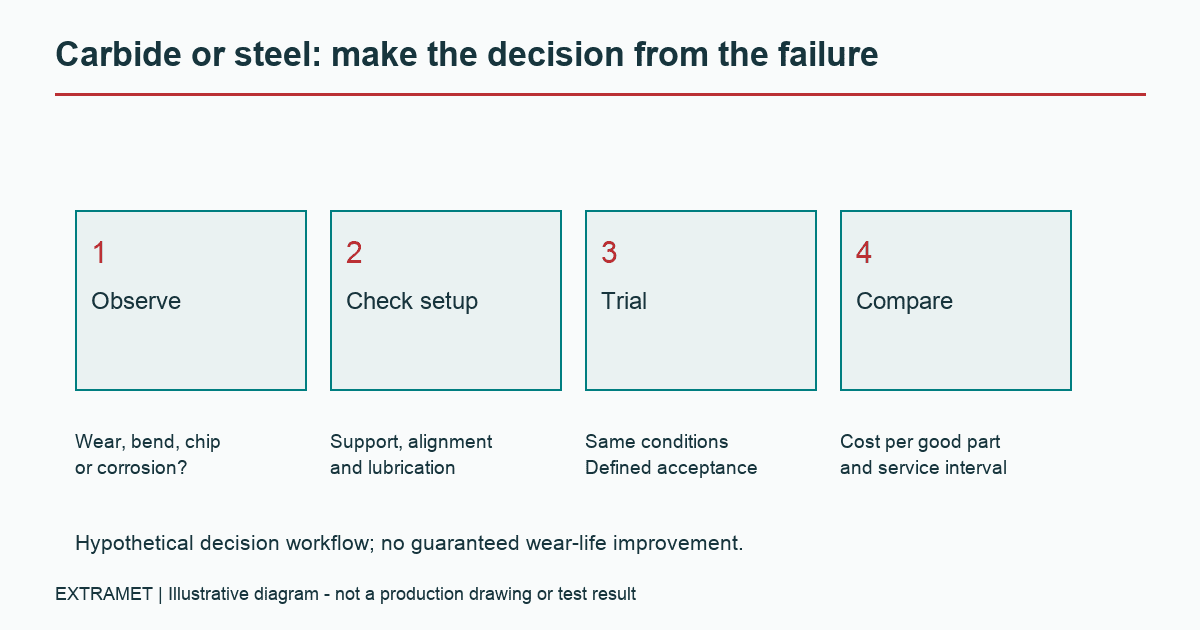
Record why the old part failed
Progressive loss of size suggests a different trial than sudden fracture or bending. Record the contact material, load, alignment, lubrication and rejection limit. If the candidate chips early, a harder material alone has not solved the application.
Run the comparison under matched conditions and keep rejected parts and inspection results. Include repair, scrap and setup costs when they materially affect the decision. Use the fillable replacement trial record to keep assumptions separate from observations.
Start with the failure mode
If a steel wear part is losing diameter, edge form, or surface finish because of abrasion, carbide may be the better engineering choice. If it is breaking because of impact or misalignment, simply switching to carbide can make the problem worse.
Why carbide holds size
Tungsten carbide combines hard carbide grains with a metallic binder. That structure gives it exceptional hardness and wear resistance, which helps pins, bushings, punches, guides, and wear components maintain dimensions over longer runs.
When steel still belongs
Steel remains useful where toughness, ductility, weldability, or low cost matter more than wear life. Many successful tools combine steel support structures with carbide wear surfaces or inserts.
Frequently Asked Questions
Is carbide always better than hardened steel?
No. Carbide is better for many wear problems, but steel can be better for impact, bending, and lower-cost applications.
Can carbide be used as an insert instead of a full part?
Yes. Carbide inserts or wear surfaces can provide wear resistance while steel provides support and toughness.
What should be reviewed before switching materials?
Review load direction, impact, geometry, clearance, grade, edge condition, and the exact failure mode of the current part.
Plan a controlled replacement using the steel-to-carbide trial checklist rather than assuming the upgrade will pay for itself.
The wear-versus-impact diagnostic guide helps separate progressive loss of material from fracture symptoms.
Send the drawing, application and quantity through the RFQ form when the requirements are ready for review.
Product questions? Contact Michael Douglas, Extramet Products product expert and Sales and Marketing contact.