
Carbide and cermet saw tips should be compared against the cutting duty and the actual material grade. Tungsten carbide is widely used for demanding and interrupted cuts; cermet families are considered for heat and galling resistance. Neither family name alone predicts how a finished blade will perform.
For a blade maker considering individual carbide saw tips, this is a component-material comparison. Tooth geometry, blade support, machine condition and the workpiece still belong to the complete cutting system. A supplier’s result for a finished blade cannot automatically be assigned to a loose tip blank.
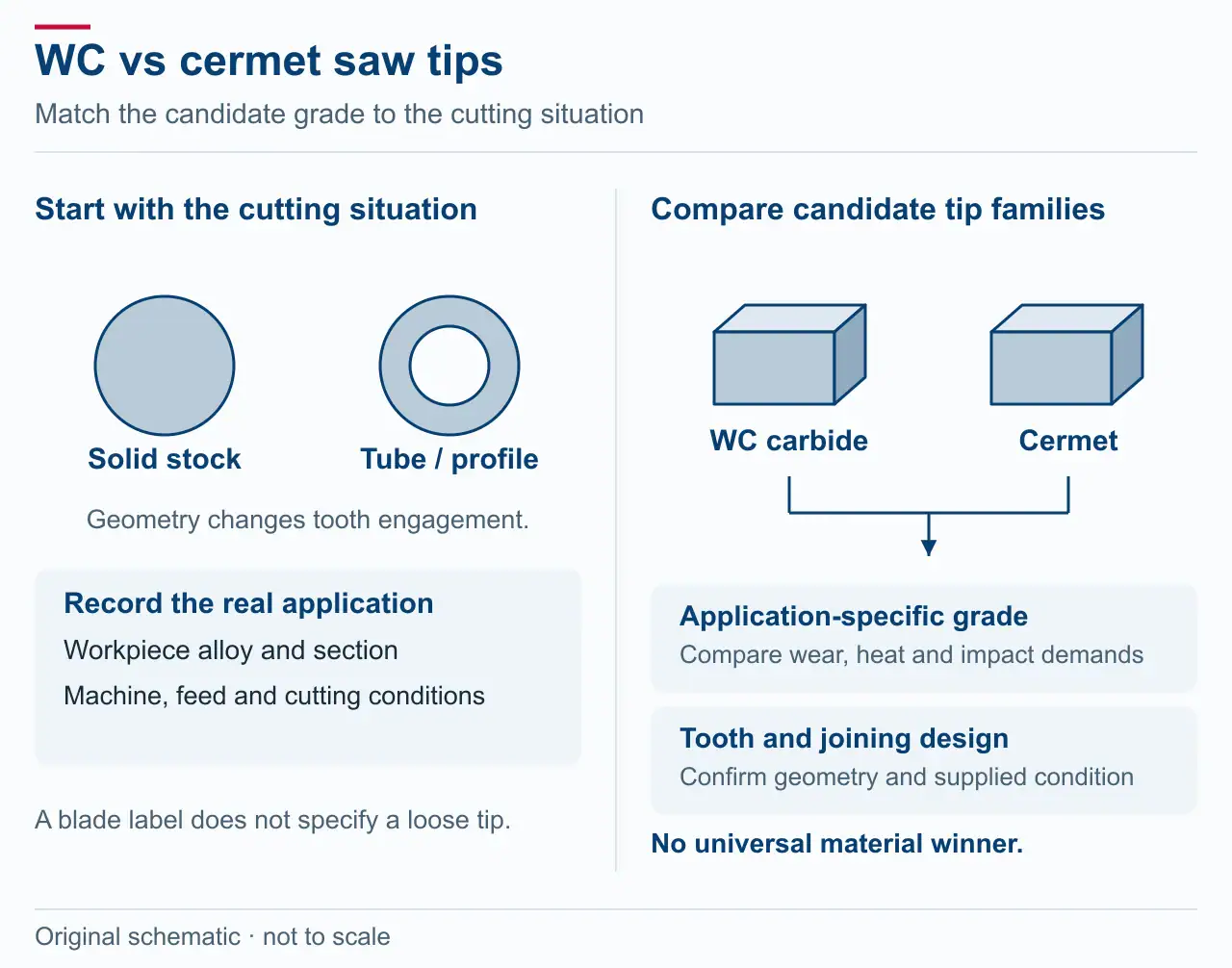
Start with the hard phase and binder
Cemented tungsten carbide contains hard WC grains joined by a metallic binder. In saw-tip terminology, cermet commonly refers to different ceramic hard phases combined with a metallic binder, including titanium carbide, nitride or carbonitride systems. The ceramic phase is part of the tip material; “cermet” does not simply mean a coating on a carbide tip.
Hyperion’s cermet saw-tip description explains this material construction and its use in circular-saw cutting edges. The important practical point is that the material family and the individual formulation are separate levels of description. Two tips labeled cermet need not have the same properties.
Describe how the edge enters the workpiece
Cutting duty includes more than the workpiece alloy. Describe whether the tooth encounters a relatively continuous section or repeatedly enters and leaves material. An interrupted cut places a different emphasis on edge damage from a steady cut in otherwise comparable material.
Hyperion’s public carbide-and-cermet selection overview identifies carbide with heavy-duty and interrupted cutting and discusses cermet’s heat-resistant behavior. These are useful starting tendencies, not a rule that every carbide suits impact or that every cermet is restricted to uninterrupted cuts.
In a comparison record, identify the workpiece form and how engagement changes during the cut. This makes a description such as “chipping on entry” more useful than a general statement that one material wore out sooner.
Keep heat, wear and chipping distinct
Hardness, heat resistance, impact resistance and resistance to welding or galling describe different aspects of cutting behavior. Heat-related edge behavior is not established by a room-temperature hardness figure alone. Likewise, a hard surface does not by itself explain why an edge chipped.
Describe the observed condition before comparing material claims. Progressive edge wear, material adhering to the cutting surface and pieces breaking away from the edge are different observations. Keep photographs, the location of the damage and the cutting conditions together. The existing explanation of wear resistance and impact toughness provides broader context without replacing the saw-specific evidence.
This separation makes the comparison more informative. A proposed material change should address the observed problem; it should not be justified only by whichever property appears highest in a table.
Compare grade evidence on the same terms
A useful supplier table identifies the grade, grain size, hardness test and strength measure, together with the application class. Hyperion’s saw-tip grade table presents those fields and marks its values as typical. Its application entries also distinguish continuous and impact cutting, including differences within the cermet grades.
Transverse rupture strength, or TRS, is bending-strength evidence. It is not a direct impact-toughness rating and does not predict a number of cuts. Compare like measurements and retain the test context. A grade name shared across quotations, or a similar hardness result, does not establish that two suppliers’ materials are equivalent.
For a cutting trial, document what is being changed and what is being held consistent. Record the workpiece, engagement, finished tooth geometry and observed edge condition. That creates a clearer comparison than combining a material change with unrelated blade or process changes and attributing the whole result to the tip family.
Bring the material decision back to the component
Once carbide is the material being evaluated, retain the tip drawing and supplied-condition requirements alongside the application description. Dimensions, finishing and joining preparation remain part of the handoff, but they do not replace the material comparison. Extramet’s saw-tip page covers those component details and explains quote review with its supply partner.
Share a drawing or current specification if available. A brief description of the workpiece and the wear or edge problem helps frame the inquiry.