
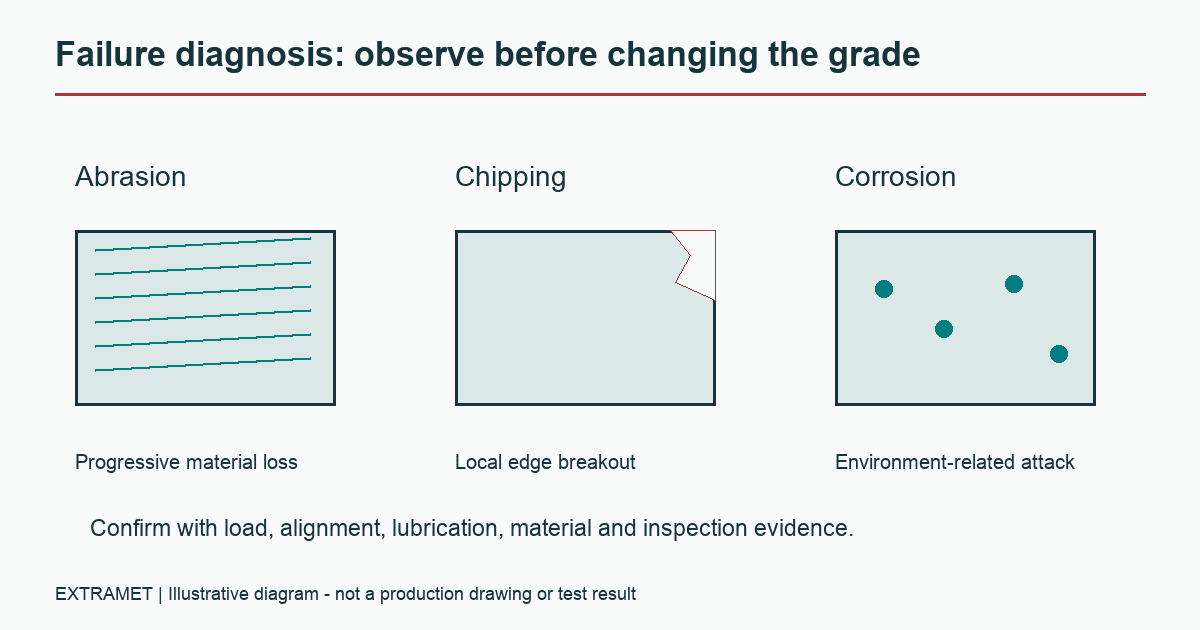
A worn surface and a fractured edge are not the same failure. Before asking for a harder carbide grade, distinguish progressive material loss from damage caused by impact, bending, alignment or inadequate support.
The broader carbide versus steel comparison covers the overall material tradeoffs.
Read the evidence before naming the cause
| Observed symptom | Questions to investigate | Useful next evidence |
|---|---|---|
| Grooves or steady loss of size | What abrasive or contacting material is present? | Wear measurements and contact history |
| Local chips at an edge | Was there shock, misalignment or poor support? | Edge images, alignment check and load direction |
| Crack or sudden break | Where did the load act and where did failure start? | Fracture origin and assembly history |
| Wear followed by chipping | Did wear change clearance or support? | Inspection measurements over the service interval |
A photograph can show a symptom without proving its cause. Preserve the failed part and note which way it faced in the machine. Compare more than one part where possible; a single handling chip can otherwise be mistaken for a grade problem.
Change one part of the diagnosis at a time
If wear is gradual and support is sound, grade and contact conditions are useful review points. If damage occurs on installation or the first stroke, investigate assembly and geometry before concluding that wear resistance is inadequate. Some applications combine abrasion and shock, so the best response can involve both grade and design.
Why tradeoffs exist
Carbide gets its performance from hard particles in a metallic binder. Increasing wear resistance can reduce toughness, while increasing toughness can reduce hardness. Steel has a different balance of ductility, toughness, and wear.
How this affects tooling
A punch, pin, die, or guide component should be selected around how it fails. A worn-out edge is a different problem from a cracked shoulder or bent pin.
Grade selection closes the gap
Within carbide, binder content and grain size let engineers tune toughness and wear resistance. The right grade is the one that survives the application, not the one with the highest hardness number.
Frequently Asked Questions
Can carbide be both hard and tough?
Yes, but every grade has a balance. The correct grade depends on the application’s wear and impact demands.
Why does steel bend when carbide chips?
Steel is usually more ductile, while carbide is harder and less tolerant of unsupported impact.
How do I compare total cost?
Compare part cost, downtime, scrap, tool changes, production rate, and expected life.
Use the punch failure checklist to collect evidence about chipping, galling, wear or breakage.
For load terminology, the carbide strength guide distinguishes hardness, compression, bending and fracture toughness.
Send the drawing, application and quantity through the RFQ form when the requirements are ready for review.
Product questions? Contact Michael Douglas, Extramet Products product expert and Sales and Marketing contact.