
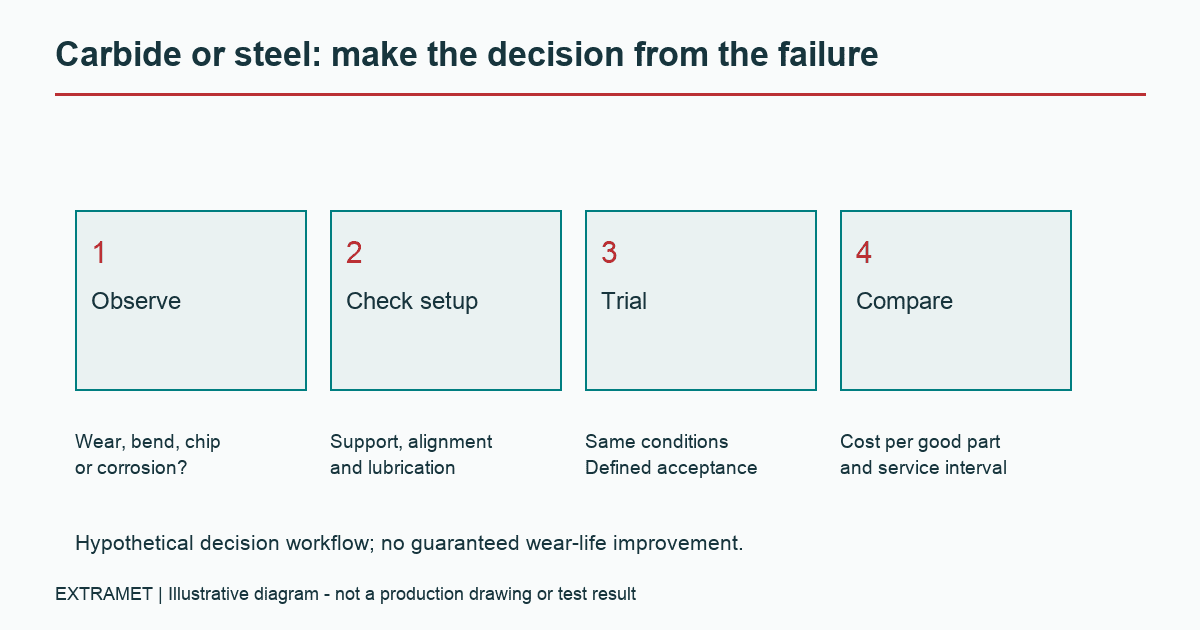
Treat a switch from steel punches or pins to carbide as a controlled trial. Agree on the failure being addressed and the acceptance rule before comparing the two materials.
The broader carbide versus steel comparison covers the overall material tradeoffs.
Five decisions before the first trial run
| Trial stage | Record before proceeding |
|---|---|
| Baseline | Current material, drawing revision, service life and failure mode |
| Design review | Support, clearance, alignment, radii and load direction |
| Candidate | Proposed grade and any geometry or finish changes |
| Acceptance | Good-part count, dimensional limits and stop conditions |
| Evaluation | Wear, chipping, scrap, changeover cost and repeatability |
For an illustrative guide pin that wears undersize, the acceptance rule might be a specific diameter limit checked at agreed intervals. For a punch that chips, inspect the edge and part quality as well as cycle count. The limits must come from the application; the worksheet does not supply universal values.
Keep the comparison fair
Changing material, lubrication and clearance at the same time makes it difficult to know what improved the result. Record all intentional changes, use matched operating conditions where practical, and stop when the agreed rejection or safety limit is reached. A single successful part is a reason to validate repeatability, not a guarantee for the whole population.
Use the fillable carbide trial record. Review the relevant punch requirements or pin requirements before ordering the trial quantity.
Good reasons to upgrade
If tool changes, scrap, or dimensional drift are driven by wear, carbide can reduce downtime and stabilize production. This is common for abrasive forming, stamping, guiding, and locating applications.
Bad reasons to upgrade
If a steel pin or punch is breaking because of side load, poor clearance, or impact, carbide may chip or crack. The process should be corrected before changing material.
The best upgrade path
Send the current part drawing, failure history, material being contacted, and production volume. That lets Extramet review whether the part needs a different grade, geometry change, or finish strategy.
Frequently Asked Questions
Will carbide always last longer?
It often lasts longer in wear applications, but not if the failure mode is impact, bending, or unsupported chipping.
Can only the working end be carbide?
In some designs, a carbide insert or working section can be paired with a steel holder or support.
What is the first design check?
Review side loading, clearance, support, and edge geometry before committing to carbide.
Use the wear-part cost comparison to calculate a break-even service interval from explicit assumptions.
Use the punch failure checklist to collect evidence about chipping, galling, wear or breakage.
Send the drawing, application and quantity through the RFQ form when the requirements are ready for review.
Product questions? Contact Michael Douglas, Extramet Products product expert and Sales and Marketing contact.