Cobalt binder percentage describes composition, not a complete carbide grade. Two grades with the same cobalt percentage can differ in grain structure, additives and measured properties, so percentage alone cannot establish an equivalent material.
Compare the documented carbide grades with the application before approving material.
What 6%, 10% and 15% mean in a simple composition example
| Illustrative two-phase composition by mass | WC portion | Cobalt portion |
|---|---|---|
| 6% cobalt | 94% | 6% |
| 10% cobalt | 90% | 10% |
| 15% cobalt | 85% | 15% |
This table is arithmetic for simplified WC-Co compositions. It is not an Extramet grade chart and excludes other possible constituents. It does not assign hardness, density or strength values to those percentages.
Why property comparisons need a controlled basis
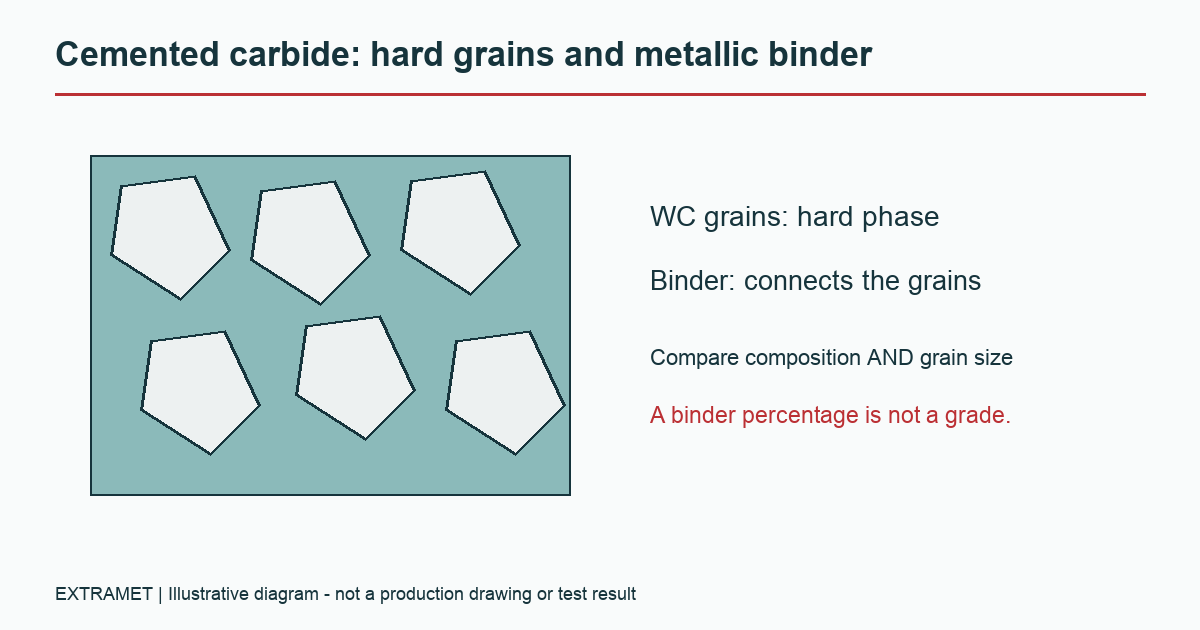
The binder connects the hard carbide grains. In otherwise comparable WC-Co materials, changing binder content changes the balance of properties. But a commercial grade comparison often changes more than one variable, including grain size or formulation. That makes a simple percentage-to-performance rule unreliable.
Hyperion describes WC-Co grades using both binder content and WC grain size; see its WC-Co grade overview. Use the actual supplier data for quantitative comparisons rather than estimating HRA or toughness from cobalt content.
Read the grade sheet in pairs
| Read together | What to verify |
|---|---|
| Binder amount and binder chemistry | Mass-percent basis and any other constituents |
| Grain description and method | Whether the supplier definitions are comparable |
| Hardness and test method | HRA or Vickers basis and any stated test conditions |
| Strength or toughness data and test | Avoid mixing unlike methods or treating test strength as a design limit |
| Density and grade identity | Use the material actually being ordered for weight calculations |
A documented Extramet comparison: EMT 207 and EMT 210
| Published grade data | EMT 207 | EMT 210 |
|---|---|---|
| Cobalt content | 7.5% | 10.0% |
| Average grain size | Approximately 0.8 micrometers | Approximately 0.8 micrometers |
| Density, ISO 3369 | 14.70 +/- 0.10 g/cm3 | 14.45 +/- 0.10 g/cm3 |
| Hardness, HV30 / ISO 3878 | 1,680 to 1,780 | 1,540 to 1,660 |
Sources: the EMT 207 sheet dated August 16, 2022 and EMT 210 sheet dated June 1, 2022, currently linked from Extramet’s grade page. These published values illustrate a comparison at the same stated average grain size. They are not a universal cobalt-to-hardness formula. Confirm the current material specification before purchasing.
Apply the comparison to a real decision
Suppose a supported wear surface is losing size gradually. Record contact conditions and confirm that abrasion is the issue before comparing candidate grades. If a thin edge is chipping, check support, load and geometry first. These are investigation paths, not recommendations to increase or decrease cobalt by a fixed amount.
What to include when requesting a substitution
Send the current and proposed grade designations, complete data sheets, drawing and reason for the change. Identify which requirements must remain unchanged and how the candidate will be trialed. Keep approval with the drawing revision and purchase record. A buyer should not accept “same cobalt percentage” as the entire equivalency statement.
The binder drawing is a conceptual illustration, not microscopy or a measured structure. Final grade approval requires the application’s technical review.
Use the grade-selection workflow to connect the application evidence with a documented material choice.
For unfinished material, review blank grade selection before approving substitutions or releasing downstream grinding.
Send the drawing, application and quantity through the RFQ form when the requirements are ready for review.
Product questions? Contact Michael Douglas, Extramet Products product expert and Sales and Marketing contact.