

Carbide Grain Size: Fine, Submicron and Coarse Grades
Fine, submicron and coarse describe carbide grain structure, but the labels must be read using the supplier’s definitions.
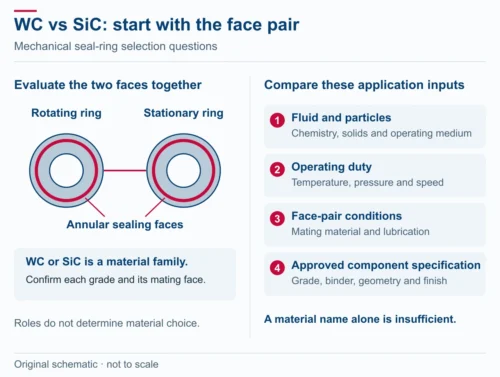
Tungsten Carbide vs Silicon Carbide Mechanical Seal Faces
Tungsten carbide and silicon carbide are both used for mechanical seal faces, but the material name alone does not define a replacement. Learn how binder or ceramic composition, the mating face and lubrication change the comparison.
Cobalt Binder in Carbide: Composition and Grade Selection
Cobalt binder percentage describes composition, not a complete carbide grade.
Grinding Carbide Shoulders, Steps and Tapers: Drawing Guide
Stepped carbide parts need a drawing that relates each diameter, shoulder and taper to the functional reference geometry.
Carbide Surface Finish: Ra, Measurement and Drawing Callouts
Specify surface finish as a measurable requirement on a named surface.
EDM vs Diamond Grinding for Carbide: Geometry and Surface Integrity
EDM and diamond grinding solve different carbide geometry problems.
Carbide OD Grinding Tolerances: Diameter, Roundness and Inspection
An OD size tolerance, roundness requirement and surface-finish requirement control different things.
Carbide Punch and Die Grades: Match the Load and Failure Mode
A carbide punch and its mating die do not automatically need the same grade.
Straight and Pilot Carbide Punch Drawings: What to Specify
A straight punch drawing and a pilot punch drawing should distinguish working geometry from locating and supporting features.
Carbide Punch Failure: Chipping, Galling, Wear and Breakage
Chipping, galling, gradual wear and complete breakage call for different checks.